Why your anxious patient takes ages to go to sleep

We all know it and we have all seen it - terrified patients take a lot longer, and a heap more sleep juice to anaesthetise.
This kind of makes intuitive sense, given anxiety and panic is the pole opposite of deep relaxed sleep, but on a pharmacological level it's even more interesting.
As always, we'll start with the basics, and layer it up as we go.
Arm brain circulation time
Let's start with our mythical, healthy 70 kg patient of textbook lore, with a cardiac output of around 5 litres per minute.
This would mean the blood is flowing at around 0.3 m/s in the aorta, slowing down to 100th of that pace in the peripheral capillaries to facilitate useful diffusion.
Here's roughly how long blood takes to get from one bit of the body to another:
- Forearm vein to right atrium = 3 - 4 seconds
- Forearm vein to left ventricle = 6 - 8 seconds
- Forearm vein to brain = 15 - 20 seconds
- Foot vein to brain = 35 - 45 seconds
Sleepy time
Now let's assume you've boshed in a grey like the absolute sniper that you are, and are injecting a standard induction dose of propofol to our ASA minus 1 patient.
If you're injecting into the arm, it'll take at least 15 - 20 seconds for the first molecules of propofol to reach the brain.
- The molecules establish a concentration gradient
- They diffuse into the fatty membranes of the neurons and white matter
- They find their way to the GABA-A receptor
- They bind to their transmembrane allosteric modulating site
- Chloride floods in
- The neuron hyperpolarises
- Neuronal activity quietens down to the point where consciousness fails to manifest and the patient falls into what we incorrectly label 'sleep', but that's a rant for another day
All of this takes time, no matter how fast those molecules move.
An induction dose of propofol is reasonably considered to be between 1.5 and 2.5 mg/kg as a baseline reference point, with enormous caveats as to why it can vary enormously between patients.
Two memorable examples
- A hypothermic, acutely intoxicated, hypothyroid and somehow pregnant 85 year old patient would need much less
- An 18 year old who drinks fifty units a week, has just taken cocaine and has a core temperature of 38°C needs rather a lot more
But generally speaking, all things considered, 2.5 mg/kg delivered as a bolus should be more than adequate for hypnosis.
So why is it when I'm running my elective gynae list for anxious but otherwise fairly fit young patients, all of this seems to go out of the window and they're still looking at me after 3 mg/kg of propofol?
Bear with me as we meander down a rather peculiar analogy to explain what's going on.
A weird analogy
Imagine you and a particularly bored friend are standing about twenty meters apart on the bank of a very small stream.
- You are holding a large bucket of neat orange squash
- Your friend, who is downstream from you, has a straw
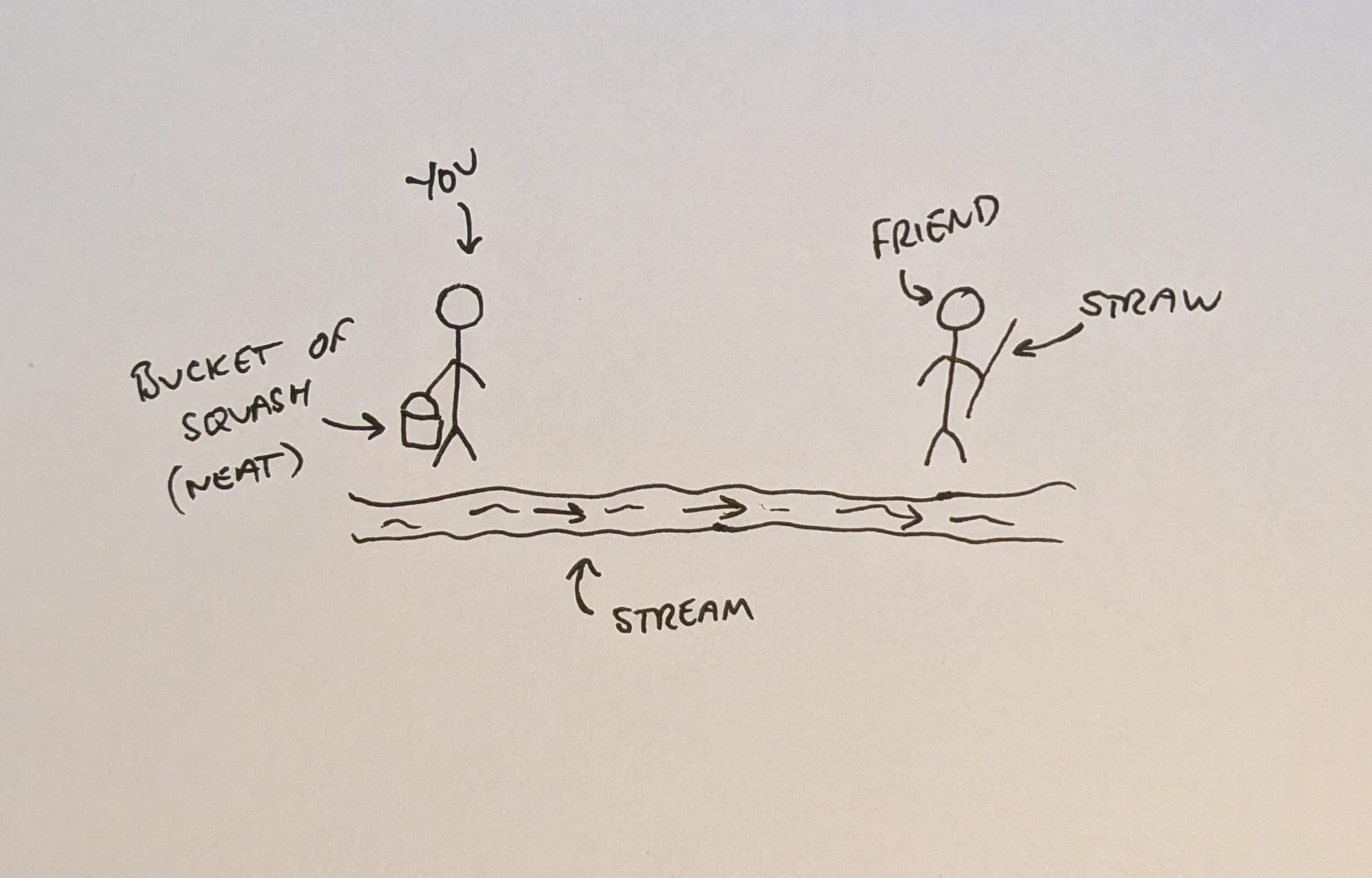
The game is very simple.
You pour some squash into the stream, and then a few seconds later your friend tastes the water.
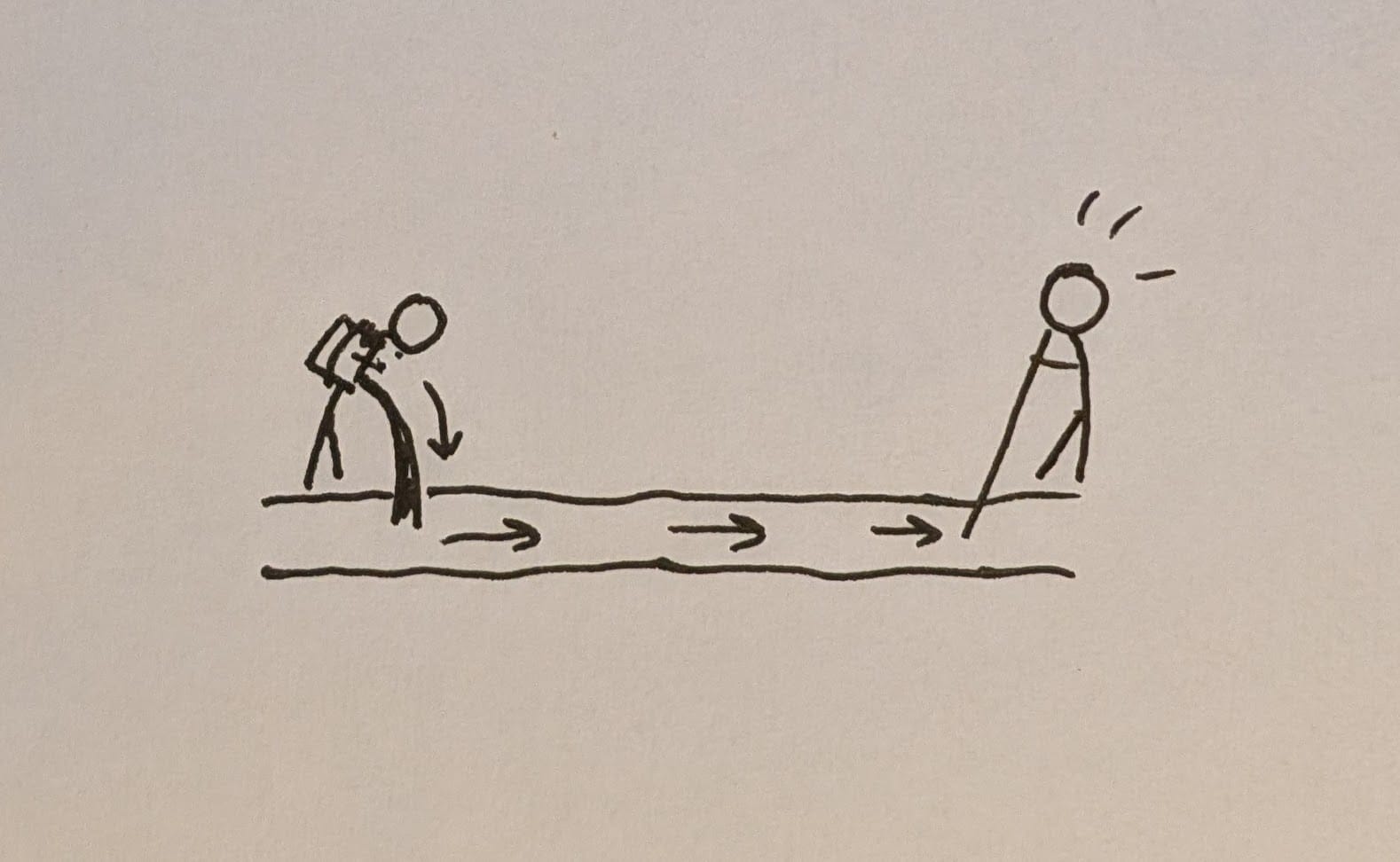
Two things should become immediately clear:
- If you dunk more squash in at once, it will taste increasingly sweet
- If you trickle the squash in very slowly, there's a good chance it'll be so dilute that your friend never tastes it at all
It's a similar idea with propofol.
If you blast a whole syringe in very quickly, then the arterial concentration of propofol will be dramatically higher and the patient will experience a much steeper concentration gradient between their plasma and their neurons (and myocytes).
The patient will fall asleep rapidly and deeply, and will have more cardiovascular side effects.
Equally if you trickle the propofol in at a rate of one millilitre every hour, the arterial concentration will remain so low they'll never fall asleep at all.
Now let's boost the stream
We're going to upgrade our stream so that it's flowing faster, to simulate increased cardiac output.
Assume we're keeping our rate of injection (or pouring squash) the same.
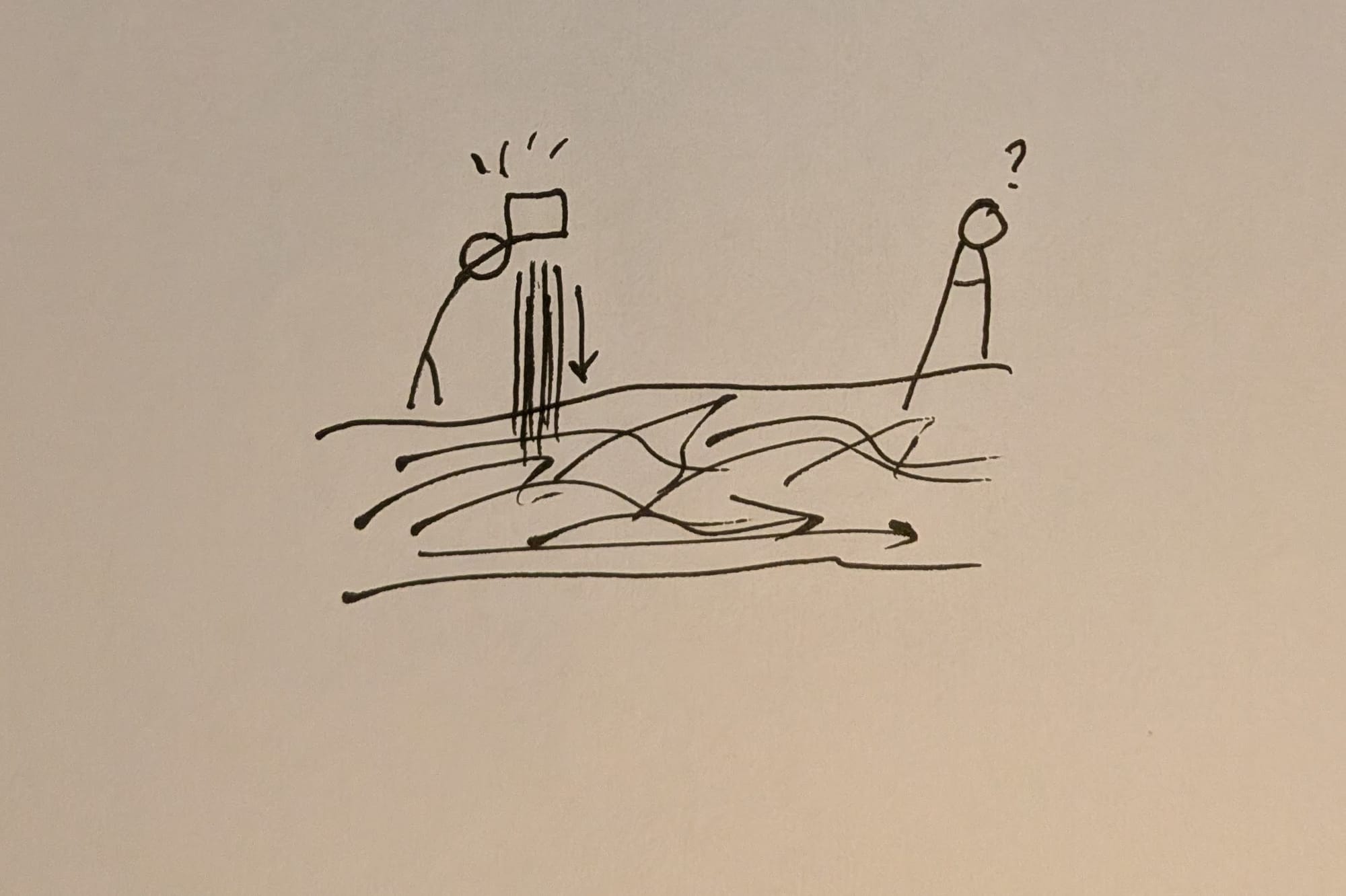
Now we see that two things happen:
- The first few molecules of squash are carried along faster, and so reach our friend sooner
- Our squash is more dilute than before, because more water has been introduced in the same amount of time
Again - similar for propofol.
When your hyperanxious tachycardic patient lies on the table with double their normal cardiac output, your injection of propofol will reach their brain slightly sooner, but the arterial concentration will be substantially lower.
This means the amount of propofol needed to achieve the same concentration gradient is higher, or you need to give it more quickly.
This diluting effect of an elevated cardiac output is also (in part) why obese patients also seem to require more propofol.
Out of interest, if you were to try and anaesthetise an elite athlete immediately after an intense workout, you'd be contending with a cardiac output of up to 35 litres per minute.
And now the opposite
Let's change tack, and dehydrate our stream down to a measly trickle.
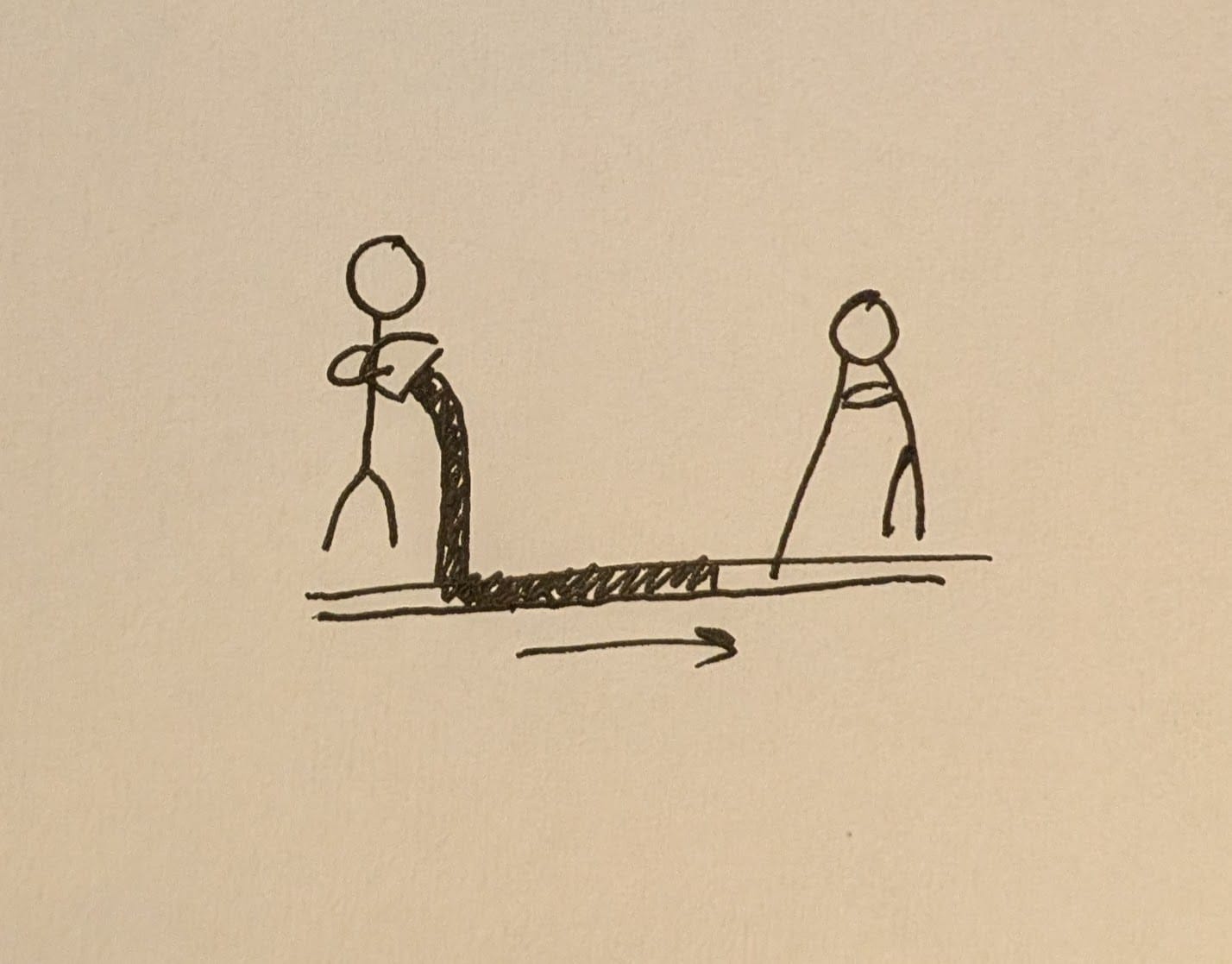
Now when you pour your quadruple-concentrated squash in, there is so little water available to dilute it that the section of stream between you and your friend becomes almost entirely composed of neat squash.
It will also take much longer to get to your friend, as the flow rate is hugely reduced.
But when it finally does reach the tip of your friend's straw, they'll be hit by the full force of the essentially neat squash that's just landed on their tastebuds.
When anaesthetising patients with a very poor cardiac output, you need to give the propofol much more carefully, because there is going to be a substantial delay before it reaches the brain.
The main risk is assuming that the delay in onset is due to an inadequate dose, and then bashing in more before the first bolus has even reached the effect site.
I recently intubated a periarrest patient in the cardiac catheter suite, and they were still breathing two minutes after an RSI dose of rocuronium, because it simply hadn't been pumped around the body yet.
It's not a perfect analogy
Because it's not exactly the same as propofol in the blood stream. The circulation isn't a single pipe full of fluid, and propofol is distributing into a variety of tissues, 98% of it is binding to proteins in the blood, and regional blood flow is going to vary depending on a multitude of factors.
But at what point along 'I've got a bucket of Ribena and a mate with a big straw' did you think this was going to be a scientifically rigorous analogy?
It still illustrates a key point quite nicely though.
There are only two variables you control
As you're standing there with syringe in hand, pause momentarily to consider the fact that there are only two* variables within your control for your next action:
- How much you inject
- How fast you inject it
*(three if you add in spraying it all over your ODP as you try to force 20 ml through a blue cannula in three seconds.)
Both the total dose you give, and the rate at which you give it, will determine exactly how propofol affects the patient.
Check out these numbers.
The numbers that matter
This will vary person to person, depending on their individual receptor phenotype and sensitivity to anaesthetic agents (e.g. chronic alcohol use as we've already mentioned) but as a general rule:
Steady state plasma concentration required for hypnosis
- 2 micrograms/ml*
Plasma concentration for myocardial depression
- 10 micrograms/ml
*Note that this is at steady state, to maintain hypnosis, not to induce it. Our bolus dose needs to produce a concentration higher than this to facilitate adequate diffusion into the brain for propofol to do its job. These also aren't target concentrations for induction, as the concentration-effect relationship during a rapidly changing bolus is much more complicated.
They're just useful numbers to show that hypnosis and cardiovascular depression occur over overlapping concentration ranges, which is why blindly creating an enormous arterial peak isn't necessarily helpful.
Here's what happens
Let's assume we're injecting 200 mg of propofol over 20 seconds
- We're giving 10 mg per second
- If cardiac output is 5 L/minute, then 83 ml of blood is being pumped out of the heart per second
- If we double cardiac output to 10 L/minute, it becomes 167 ml per second
- So our propofol is being diluted in double the volume, producing a much lower initial arterial concentration
These guys demonstrated this impressively well - reducing CO by 2.2 litres per minute increased propofol concentration by 43%
What about if I inject over 10 seconds?
- Let's keep the cardiac output fixed at 5 litres/minute
- If we inject over 20 seconds, we end up giving 200 mg into 20 x 83 = 1660 ml of blood, giving a theoretical concentration of around 0.12 mg/ml or 120 microgram/ml
- If we inject over 10 seconds, we give 200 mg into 10 x 83 = 830 ml of blood, giving a concentration of 0.24 mg/ml or 240 microgram/ml
Note these are not arterial concentrations to hang your hat on, as they don't account for the myriad factors that affect propofol distribution including but not limited to mixing, pulmonary uptake, recirculation, tissue distribution, protein binding and regional blood flow.
They are merely conceptual examples to illustrate the profound impact of your speed of injection on how quickly propofol is delivered to the brain.
What if I inject 100 mg/kg over three weeks?
The only conceivable situation in which this would be even remotely ethical would be a complex bespoke anti-emetic regimen for a patient undergoing some new, highly emetogenic treatment for three weeks as an impatient.
Ethics aside, let's dive well outside the bounds of pharmacokinetic validity and make up some numbers.
- Three weeks of cardiac output = 3 x 7 x 24 x 60 x 5000 ml = 151200000 ml
- 100 mg/kg = 7000 mg
- This gives a theoretical concentration of 7000/151200000 = 0.000046 mg/ml or 0.046 mcg/ml
- This is without even thinking about the rate of propofol clearance from the body (which would in all probability exceed the rate of administration and tend towards a concentration of precisely zero)
- Furthermore it would be insane to call this a 'bolus' anymore - it's clearly a substandard infusion - so the whole argument falls to pieces anyway unless you dive into the nitty gritty of infusion kinetics and clearance, which is certainly for another day
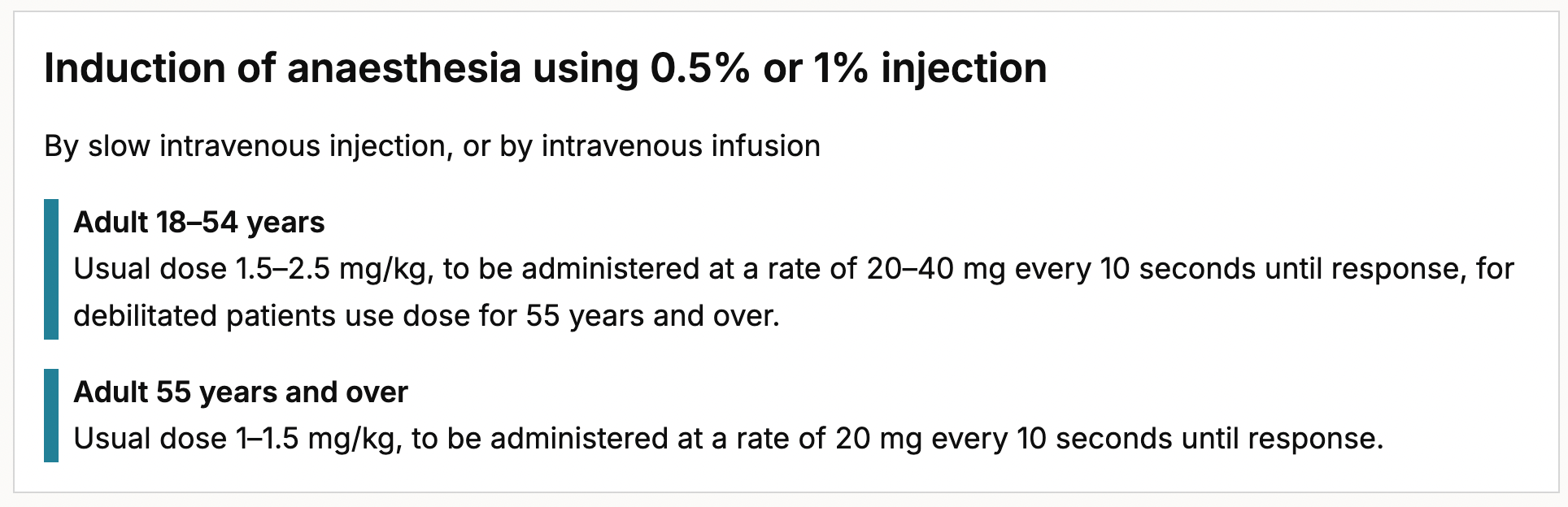
This is a just ludicrous example to demonstrate that it's not just the total dose, but the rate at which you're giving it that will impact the clinical effect it has on the patient.
That's why the BNF says this:
What do I take home from this?
When you give a bolus dose of propofol, you want enough arterial concentration to encourage propofol into the brain, which you can influence by:
- Giving a certain dose
- Giving it at a certain speed
But once you're throwing an enormous first-pass peak past the brain, making that peak even larger doesn't necessarily make the patient proportionally more sleepy.
It just exposes the cardiovascular system to a much bigger peak concentration.
So when you're about to inject propofol to induce anaesthesia, it's not just 'little syringe, big syringe, igel'.
It's actually:
- What is this patient's cardiac output?
- What is this patient's likely anaesthetic requirement?
- What other drugs, (medical, recreational or endogenous), are going to mess with my calculations?
- Where's my cannula, and how long am I expecting them to take to fall asleep?
- When am I going to decide whether they're 'asleep enough' for muscle relaxation or airway manipulation?
Then it's little syringe, big syringe, igel.
References and Further Reading
 Jordan King
Other nerdy deep dive posts
 Anaestheasier ltd.
 Anaestheasier ltd.
 Anaestheasier ltd.
The Toolkits
Everything you need to smash the exams, all in one place.


Just a quick reminder that all information posted on Anaestheasier.com is for educational purposes only aimed at trained professionals, and it does not constitute medical or clinical advice.
Anaestheasier should not be used as a definitive resource for academic writing, please reference original source material.
Anaestheasier® is a registered trademark.