Oil and Blood Gas coefficients

We learn in anaesthesia school that, when discussing anaesthetic vapours:
- Oil:gas partition coefficient correlates positively with potency
- Blood:gas partition coefficient correlates negatively with speed of onset
And most of us leave it at that, with the numbers memorised neatly for the exam and then promptly forgotten about.
But what does it actually mean?
'Amount' does not equal 'partial pressure'
This is a good place to start, because once you separate these two concepts the whole idea gets a bit easier to understand.
We're used to thinking in terms of 'doses' and 'concentrations' for our intravenous and oral medications, because it's the number of molecules that are going to make the pharmacological difference, interacting with receptors and whatnot.
For vapours, however, it's less about the sheer quantity of molecules, and more about the partial pressure that they exert that matters.
Instead of concentration gradients, molecules move down partial pressure gradients:
- Inhaled partial pressure
- Alveolar partial pressure
- Arterial partial pressure
- Brain partial pressure
By applying a greater partial pressure at the top of the chain, we set up a steeper gradient down the line, so everything happens more quickly.
Remind me what partial pressure means
- All molecules in a gaseous mixture have energy and therefore move around
- Together they exert a pressure on their container
- Each component of the mixture (nitrogen, oxygen, sevoflurane) exerts pressure independently, called a partial pressure
- The sum of these partial pressures is the total pressure
This is Dalton's law.
Henry's law then gives the relationship between dissolved concentration and partial pressure:
- Concentration in solution = solubility coefficient × partial pressure
Partial pressure tells us the 'escaping tendency' or driving force of those molecules.
A very highly soluble gas can have loads of molecules dissolved without exerting much partial pressure, and vice versa.
Strictly speaking, molecules dissolved in a liquid aren't bouncing around and exerting pressure on the walls in the same way as molecules in a gas or vapour phase.
When we mention the 'partial pressure' or 'tension' of a dissolved gas, we're really describing the partial pressure of gas with which that solution would be in equilibrium.
What is a partition coefficient?
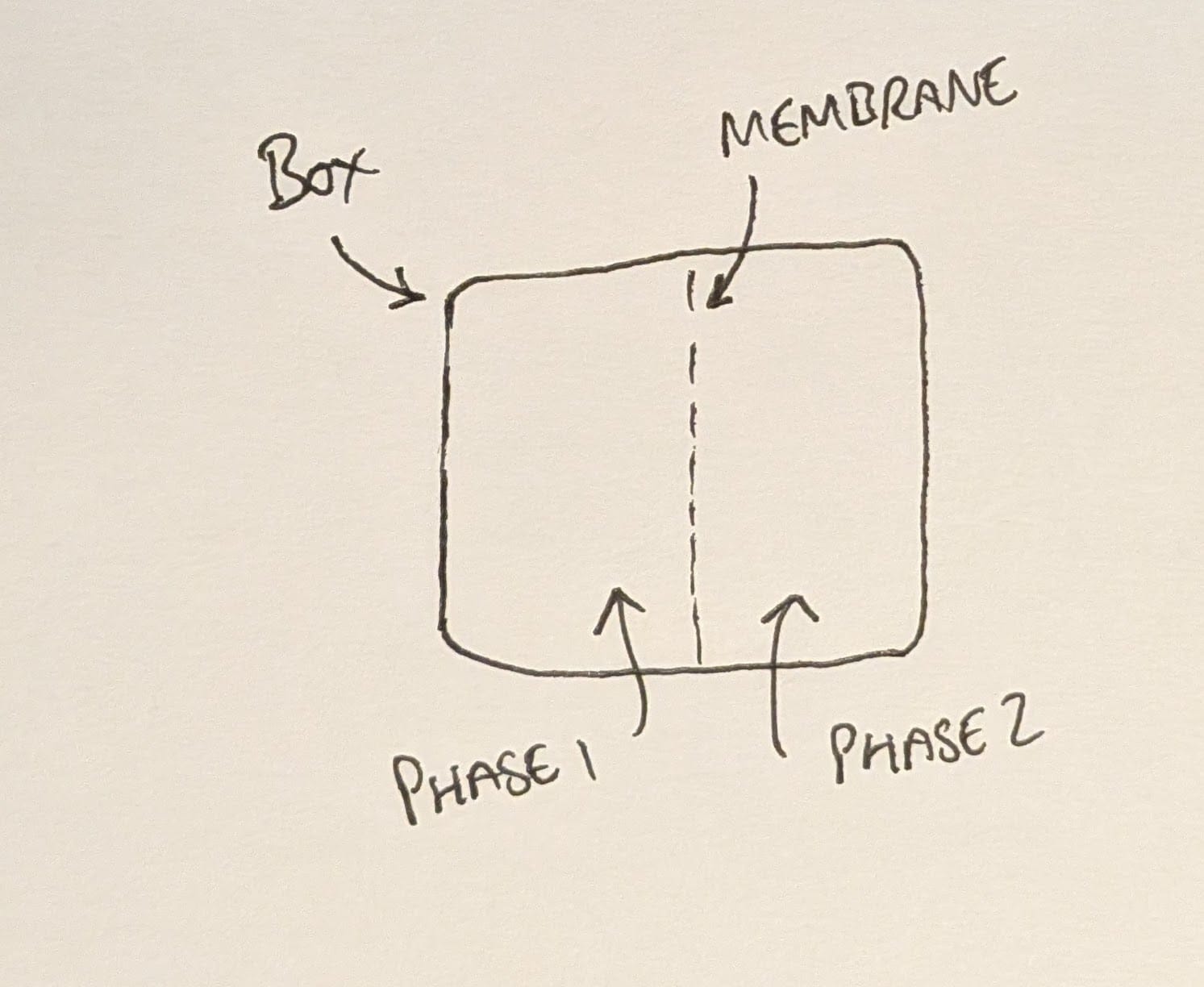
Start with a closed box separated into two partitions, with some sort of membrane separating the two.
Each partition contains a phase, which can be a solid, liquid or gas.
Then let's introduce a cup of our finest sevoflurane, and let it swill throughout the partitions (it can pass through the membrane) until it reaches some form of equilibrium.
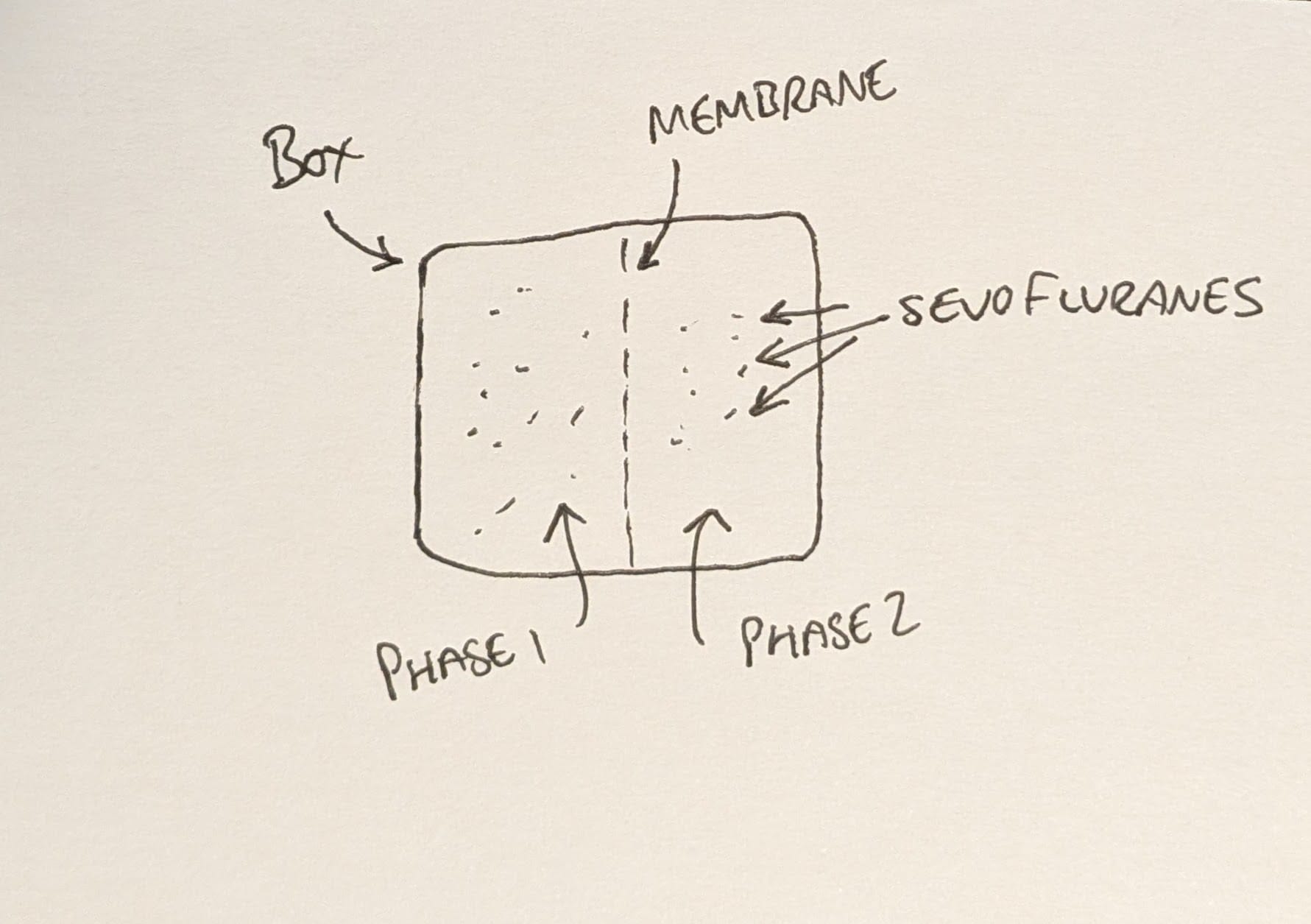
At the risk of over-anthropomorphising our cute little sevofluranes, most molecules generally demonstrate some sort of preference as to whether they end up dissolved in water, or fat, or remain in a gaseous state.
This means that at equilibrium, if the two partitions contain different phases, there will be more sevoflurane molecules on one side than the other.
The ratio of molecules on one side compared to the other is a partition coefficient.
Partition coefficient simply means 'preference to sit in phase rather than another'
A coefficient of 10 means that at equilibrium, one phase contains ten times the number of vapour molecules of the other.
So what's an oil:gas coefficient?
You have a box with two chambers and a semi-permeable membrane between as described above.
One chamber is full of oil, the other full of room air.
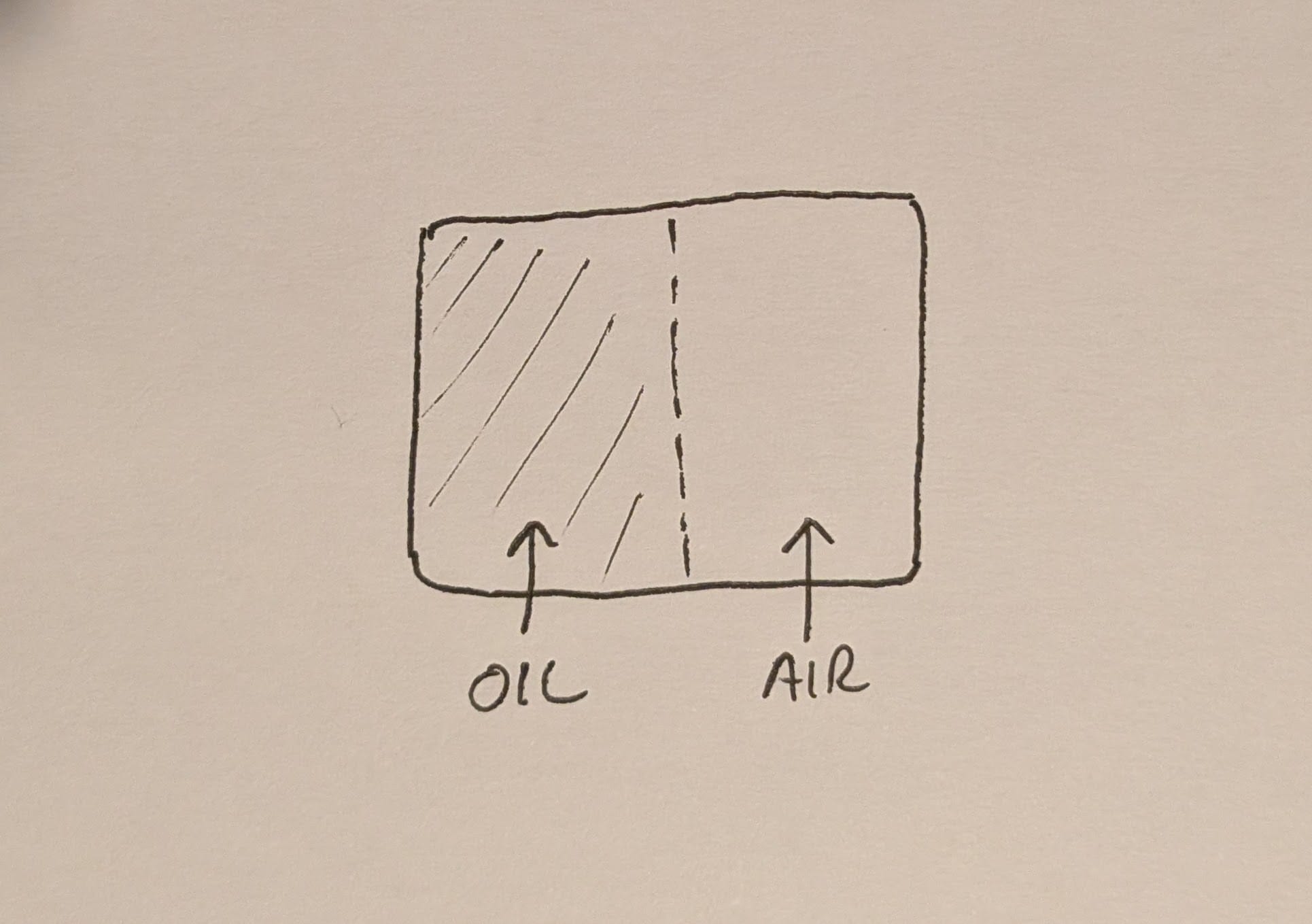
In goes the sevoflurane, and you leave it to settle, allowing the partial pressure of sevoflurane in each chamber to equilibrate.
You come back and measure the concentration of sevoflurane molecules in each chamber, and find that there are forty seven times more molecules sitting in the oil than the gaseous phase.
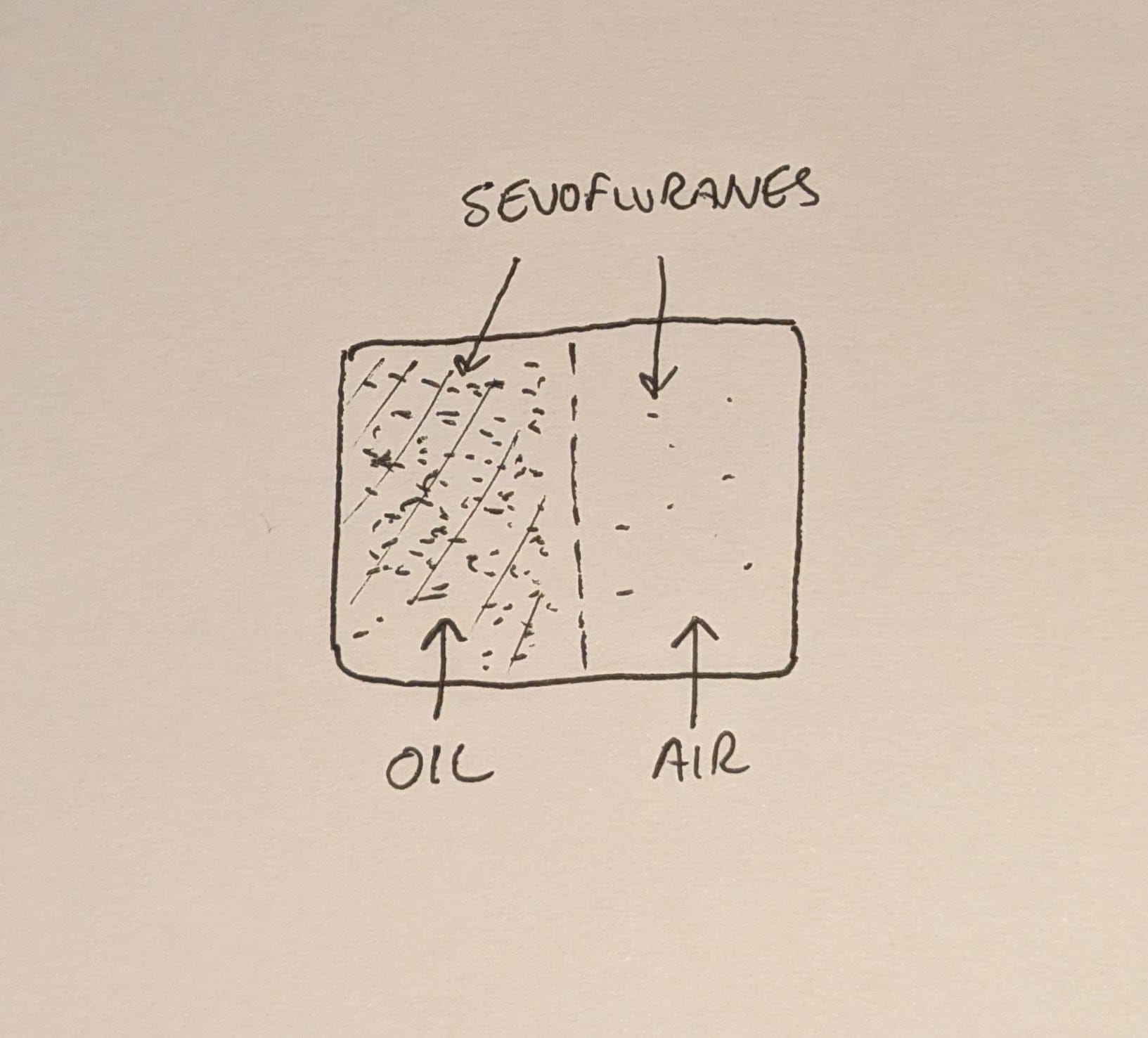
The oil:gas partition coefficient of sevoflurane is therefore 47, meaning it is highly lipid soluble and very keen to sit in the oil.
Some oil:gas coefficients to know
- Halothane - 224
- Isoflurane - 91
- Sevoflurane - 47
- Desflurane - 19
So how does this relate to potency?
What's potency?
Simply put, potency just means 'how much drug is required to produce a defined effect.'
- MAC is minimum alveolar concentration required to achieve a certain level of anaesthesia
- Smaller MAC = more potent
- Technically it should be minimum alveolar partial pressure as we've discussed above but that's an argument for another day that you can find here
A more potent agent needs less partial pressure to generate a clinical effect, and therefore has a lower MAC.
MAC values to know:
The numbers you need for the exam are the MAC50 values for a 40 year old adult, defined as the minimum alveolar concentration required for half of the population to not move in response to a noxious surgical stimulus.
The numbers in brackets are the corresponding MAC50 values for a 1 year old and 80 year old, to show how age affects the requirement:
- Halothane - 0.75% (0.95 at 1 year old, 0.58 at 80)
- Isoflurane - 1.2% (1.5 and 0.9)
- Sevoflurane - 2.1% (2.3 and 1.4)
- Desflurane - 6.6% (8.3 and 5.1)
MAC is an experimentally derived clinical endpoint that changes with age and other factors.
MAC requirement drops by about 6% per decade in adults.
So what's this Meyer Overton business?
In the early 1900s, we find two legends of anaesthesia hard at work:
- Hans Horst Meyer
- Charles Ernest Overton
Working independently they both realised that anaesthetic potency appeared to correlate impressively positively with lipid solubility.
Given we had exactly zero idea as to how these magical anaesthetic drugs worked at the time, this led them to draw the not-ridiculous conclusion that maybe that's how the anaesthetic agents were exerting their effects - by messing with lipid membranes or something.
For many years this theory of 'more oil soluble = better anaesthetic agent' held water (pun intended).
Then we discovered the structure and function of the GABA-A receptor and figured out this solubility-potency relationship was correlational, not causal.
What did we do before MAC?
We guessed.
We looked at our patient (shock horror) and assessed things like their:
- Heart rate
- Respiratory pattern
- Pupils
- Reflexes
- Evidence of movement or flinching
And decided whether they needed more or less anaesthesia.
That is until Eger, Saidman and Brandstater's landmark 1965 paper established minimum alveolar concentration as a standard measure of anaesthetic potency.
Here's a wonderful passage from Eger's more recent article:
Giles and I told of our technique for determining the minimal alveolar anesthetic concentration, and John connected this to the ratio of the speed of an airplane relative to the speed of sound (a MAAC ratio). John now says it never was clear why we chose MAC rather than MAAC. I don't remember either, except that we wanted to emphasize the word “alveolar.” Besides, voicing “MAAC” might make us sound like bleating sheep rather than anesthesiologists.
How does blood:gas partition coefficient affect speed of onset?
Unlike the Meyer–Overton relationship, which is an interesting correlation, the blood:gas coefficient directly impacts the uptake of the anaesthetic agent, and therefore the partial pressure gradient generated with the brain.
And conveniently this time we don't need to imagine a box with a membrane, because we can just use the alveolus and pulmonary capillary.
Let's take two imaginary vapours:
- Vapour A has a blood:gas coefficient of 0.5
- Vapour B has a blood:gas coefficient of 100
This means that at equilibrium, there are half as many molecules of vapour A in the blood as in the gas above it (or in the alveoli).
Meanwhile there are a hundred times as many molecules of vapour B in the blood compared to gas.
Then you ask:
"If I start pouring in anaesthetic vapour, for which vapour does the blood act as a bigger sink?"
- For vapour A, the partial pressure required to keep it in solution starts to go up very quickly
- For vapour B, it keeps on drinking it up with a much slower increase in partial pressure
How this leads to speed of onset
If we work backwards, speed of onset is simply 'how quickly do molecules get to the brain and start working?'
Clearly a number of factors are going to play a role here:
- How much vapour you're breathing in
- How fast you're breathing
- How fast the blood is moving
But the parameter we're interested in is:
- What is the partial pressure gradient between the blood and the brain?
This is the key point, because a vapour that is very soluble in the blood will generate very little partial pressure, so very few molecules will diffuse across into the brain to start doing their job.
A highly soluble agent requires many more molecules to dissolve in blood for its partial pressure to rise by the same amount.
That is how B:G coefficient links solubility and speed of onset, and why a lower number is faster.
In summary
- Patient inhales vapour
- Low blood solubility means less uptake from alveoli for a given rise in partial pressure
- So alveolar partial pressure rises rapidly towards inspired partial pressure
- So arterial partial pressure rises rapidly
- So the brain partial pressure rises rapidly
- So you get a faster induction
The blood gas partition coefficients to know:
- Desflurane - 0.42
- Nitrous oxide - 0.47
- Sevoflurane - 0.65
- Isoflurane - 1.46
- Halothane - 2.3
The smaller the number, the faster the onset.
This whole process also works exactly the same in reverse, meaning that vapours with a smaller blood:gas coefficient are faster to wear off as well.
So why are they inversely related?
You've probably noticed that the more potent a vapour is, the slower it tends to kick in.
This is actually a weird coincidence, rather than a rule as such.
- Highly fat soluble agents are more potent as we've described
- Highly fat soluble agents also seem to like dissolving in blood, and therefore have a slower onset and offset
This is probably due to interactions with the complex environment of cells and proteins that our volatile agents just appear to enjoy.
Note that ether has a B:G of 12 making it incredibly slow, but a O:G of 65, which makes it only slightly more potent than sevoflurane, so it rather breaks this trend.
Why do some books say the MAC of sevoflurane is 2.1% and others say 1.8%?
Because the sole purpose of the FRCA examinations is to frustrate and confuse.
Also because MAC isn't a single number for everyone, nor is it the same number for the same patient on different days of the week.
- MAC50 is the amount needed for half of the population not to flinch in response to surgical stimulus
- If your whole study population are hyperthyroid eighteen year olds who've just been skydiving, then your required MAC values are going to be much higher
- If they're all 98 year olds who've recently consumed a pint of brandy and a large pie, the value is going to tend to zero
It also depends on how you're measuring it and how good your equipment is.
- The classic Katoh & Ikeda human study reported a sevoflurane MAC of 1.71 ± 0.07% in otherwise healthy adult surgical patients
- Other studies have since produced values around 1.8
- The official FDA data sheet says 2.1% for a 40 year old adult
So the short answer is, both are correct, because MAC varies with age as well as many other factors.
The examiners care far more about whether you understand the importance of the differences between the agents, than the precise numbers themselves.
The take home messages
- We're more interested in partial pressure gradients than concentration when we talk about vapours
- A partition coefficient tells you how many more molecules are in one phase compared to another, once the partial pressures have equilibrated
- Greater lipid solubility correlates strongly with greater anaesthetic potency and therefore a lower MAC, although this relationship does not itself explain the mechanism of anaesthesia
- A less blood-soluble vapour requires less uptake from the alveolus for its partial pressure to rise, so alveolar, arterial and brain partial pressures rise more rapidly and induction is faster
- It is not a rule that more potent volatile agents are slower onset, but it does appear to be a consistent trend
References and further reading
 E I Eger 2nd
 Authors and Affiliations
 W W Mapleson
 Anaestheasier ltd.
 Anaestheasier ltd.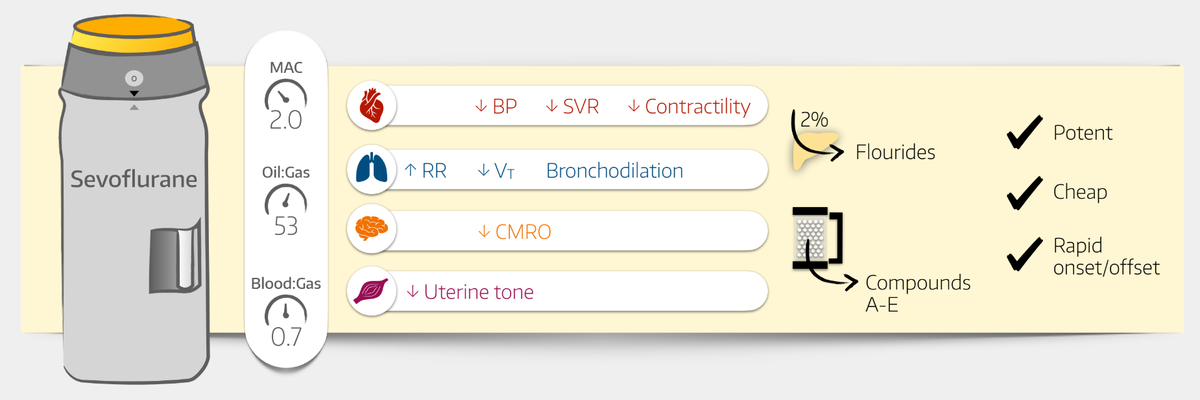
 Anaestheasier ltd.
The Toolkits
Everything you need to smash the exams, all in one place.


Just a quick reminder that all information posted on Anaestheasier.com is for educational purposes only aimed at trained professionals, and it does not constitute medical or clinical advice.
Anaestheasier should not be used as a definitive resource for academic writing, please reference original source material.
Anaestheasier® is a registered trademark.