Understanding sodium and the kidney
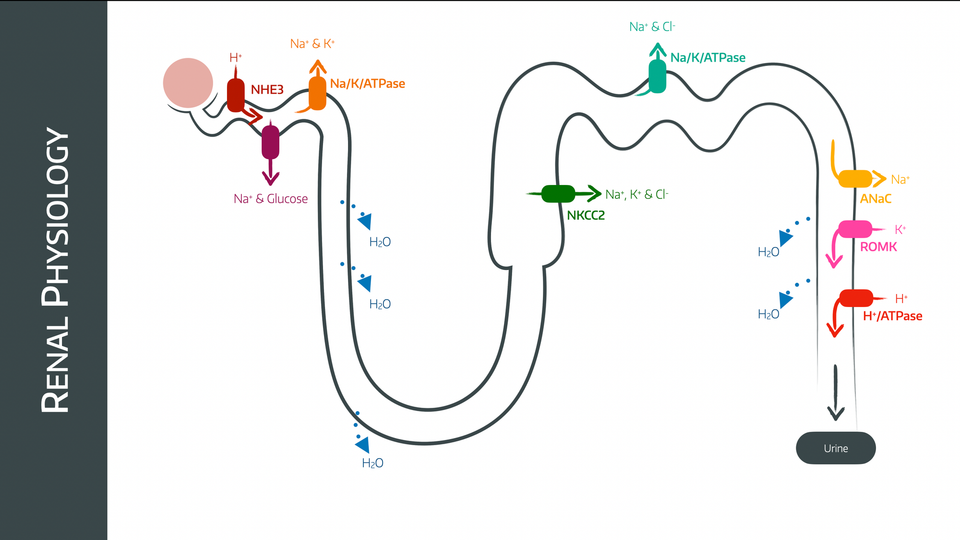
I have memorised what on earth happens with sodium in the kidney countless times for exams over many years, but I can honestly say I have never truly understood it sufficiently that I could explain coherently it in one go.
Today I change that.
This is my quest to follow sodium's journey through the nephron and figure out exactly what happens and why, and how that makes my day as an anaesthetist more interesting.
Here goes.
What is sodium for?
I find physiology much easier to comprehend if I start from the premise of 'what is the body trying to achieve?' and work backwards.
In the case of sodium, we're trying to accomplish a few things:
- Membrane electrical stability
- Useful, coordinated action potentials
- Maintaining a blood pressure compatible with life
- Keeping the body's water where it's meant to be
And that's about it, quite a lot to ask of one humble ion.
Start with the sieve
The first thing that happens is the arterial blood pours into the glomerular colander and the vast majority of small things, (less than 70 000 daltons) fall out into the tubule.
This is how the kidney has evolved to work - throw everything out, and then claw back what it actually needs - and to be fair to mother nature, it works ridiculously well.
Some numbers
Assuming a glomerular filtration rate of 125 ml/min:
- 180 litres of fluid a day drains into the tubular system
- Molecules over 70 000 daltons are not filtered
- Molecules below 7000 daltons are freely filtered
- Negatively charged molecules are repelled by the basement membrane and therefore have a reduced filtration fraction
Sodium ions are positively charged and very small indeed at just 23 daltons, so it pours merrily into the start of the proximal convoluted tubule.
Note that this process is largely due to physical or hydrostatic pressure, not electrochemical or concentration gradients.
This means you lose lots of sodium through the glomerular sieve, but you lose proportional amounts of water too, so the concentration of sodium remains essentially the same.
The proximal convoluted tubule
This is where the bulk of reabsorption of pretty much everything happens.