Top tips for using Ketamine
Ketamine rocks
Regardless of whether they actually like using it or not, most anaesthetists would agree that ketamine is a pretty phenomenal drug.
It is far from perfect, and certainly has its flaws, but few drugs in anaesthesia have quite so many tricks up their pharmacological sleeves.
I mean what other single agent can be all of the following at once?
- Hypnotic (and can be given IM)
- Sedative
- Amnestic
- Analgesic
- Bronchodilator
- Anticonvulsive
- Antidepressant
Hence we have Rule #4
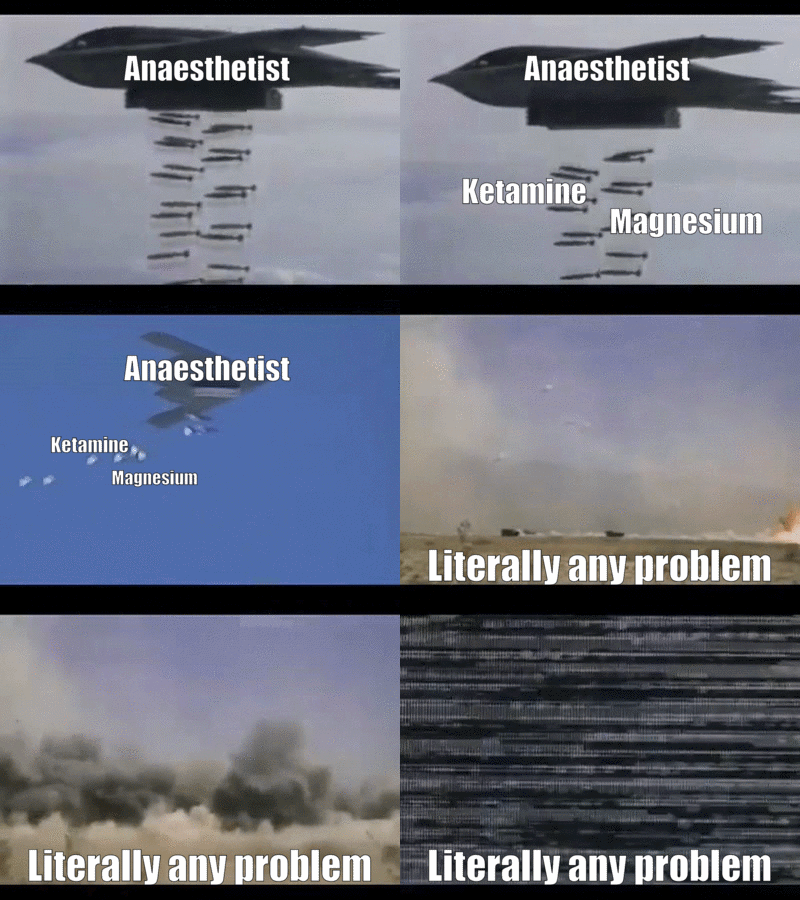
"There are few situations that cannot be improved with a can-do attitude and a load of ketamine."
What does ketamine actually do?
- Wedges itself (technical term) into the pore of the N-methyl-D-aspartate or NMDA glutamate receptor
- This slams the receptor channel shut and prevents glutamate from binding
- This prevents the calcium and sodium influx, and potassium efflux, that would normally occur when glutamate (the main excitatory neurotransmitter in the CNS) binds
- This has the effect of generally suppressing central neural transmission, hence the anaesthetic effects we see clinically
The key thing to remember is the quality of the anaesthesia it induces is different.
Ketamine produces a state of dissociative anaesthesia rather than unconscious anaesthesia, which means the patient may still have their eyes open.
What other targets does it hit?
- Mu opioid antagonist
- Kappa opioid agonist
- Nicotinic antagonist
- Dopamine agonist
- Sodium-dependent noradrenaline transporter antagonist
Among others.
This is a long-winded way of saying that ketamine is a messy drug with lots of collateral targets, especially when compared with the relatively pure GABAa modulation of propofol.
But it isn't without its drawbacks:
- Hypertension
- Hypersalivation
- Hallucinations
- Emetogenic
- Emergence agitation
So we thought we'd assemble a cheat sheet on how to use ketamine properly, to get the best out of this wonder drug.
What's dissociative anaesthesia?
Imagine you're trying to go to sleep, but your house has several noisy children clattering around and screaming their heads off keeping you awake.
- Propofol is like turning the lights down and reading a bedtime story to get them to be quiet, so you can then get some kip
- Ketamine is like putting each child in a different soundproof room so they can carry on yelling but you can't hear them
Rather than reducing neural excitability to the point that the signals are too quiet to produce a meaningful conscious experience, ketamine simply disconnects the brain's ability to integrate all of the different components instead.
Each individual component is still working, but there is no overall awareness as they're not talking to each other.
- The eyes might stay open, and you'll see nystagmus, because the visual cortex is still functional
- Breathing and airway reflexes remain intact, as the motor pathways still work
- The cortex, cut off from its steady live feed of sensory input, starts making stuff up to try and provide some explanation of reality, producing wild and vivid hallucinations
That's what we mean by 'dissociative', you haven't turned any of the incoming signals down, you've just prevented the brain from coherently integrating the information to form a useful conscious experience that they'll remember.
This is why propofol feels like 'the best sleep ever' and ketamine just feels bonkers.
Know your doses
Many drugs follow a simple process of 'a bigger dose means more of the same and maybe a bit faster', like rocuronium and your opioids.
Ketamine, however, will give wildly different effects depending on what dose you give.