What is flow controlled ventilation?
Just when you thought you'd finally got to grips with pressure and volume control modes of ventilation, along comes their newest brother - flow controlled ventilation - because apparently we need even more ways in which to inflate our patients.
This is my attempt to understand it.
- If you're a novice anaesthetist (welcome to the family by the way) and just want to understand the beginnings of ventilator modes, click here
- If you find yourself suddenly compelled to learn more about APRV, click here
If you want to follow my chain of thought as I attempt to understand flow controlled ventilation, then read on.
The TLDR
Theoretically this makes it useful for ventilating through tiny tubes, and is less damaging to the lung.
In and out
Let's start insanely simply, by stating that a ventilator does one job, which is to push gas in and out of the patient's lungs. Usually the ventilator does some pushing for the inspiratory bit, and then just relaxes and lets the gas escape passively before the next breath.
Simple enough so far.
So now we can ask the question - exactly how is the ventilator pushing gas into the patient?
There are a few options such as:
- Bag in a bottle
- Bellows
- Pneumatic
Regardless of what physical process the ventilator is using to generate said positive pressure, the end result is the same, and you're telling the computer how to apply that positive pressure to the patient.
There were previously two options
You could previously control:
- What volume of gas is shoved into the patient's lungs
- What pressure is applied, and for how long
Up until now, every conceivable mode of ventilation has simply been a version of one or both of these two concepts, pressure or volume.
When you control volume, you say to the ventilator:
- "I know I want you to give a 500 ml breath, but I don't know how hard you're going to have to push to achieve this"
You need to keep an eye on the pressures being generated to ensure they're safe, but you can be fairly sure you'll be ventilating the patient enough to clear their CO2.
Whereas with pressure control, you're saying:
- "I know I want you to push this hard, but I have no idea what tidal volume that will achieve."
You can be sure the ventilator won't deliver dangerously high pressures, but you need to check you're actually achieving enough of a tidal volume.
In young healthy lungs for elective surgery, it matters little which one you use, as long as you end up with sensible tidal volumes at reasonable pressures.
So far, so breezy.
If you'd like to digress for more nuance on these two modes, check out our post here.
 Anaestheasier ltd.
Otherwise we'll crack on with the rambling chain of thought.
So why do we need a new mode?
Reasons for introducing new ventilator modes to anaesthetic practice include but are not limited to:
- Finding more examinable material for the FRCA
- Keeping fidgety anaesthetic nerds occupied during long head and neck cases
- Solving the holy grail question of 'how can we make ventilators less damaging to the lungs?'
Having written them down, the third point is probably the most valid here.
Remind me how ventilators cause lung damage?
- High plateau pressures cause barotrauma
- Large tidal volumes cause volutrauma
- Repeated opening and closing of alveoli causes atelectotrauma
- The inflammation triggered by the above causes biotrauma
That's what you need to know for the exam.
What's interesting is that we now think it's in large part down to how much energy the ventilator is distributing into the lung tissue.
In particular, letting an inflated lung rapidly deflate in an uncontrolled manner results in more harm, at least in rat models.
A decrease in how much mechanical energy is dissipated inside the lungs may mean less damage, so a ventilator mode that optimises for less energy is probably a good plan.
To minimise energy you want:
- Constant flow
- Equal inspiratory and expiratory times
- Slower controlled expiration with minimal fluctuations in pressure
The quest to reduce ventilator-induced lung injury has driven much research, and it looks like this fancy new mode might contribute to at least part of the answer.
The new kid on the block
Meet Flow controlled ventilation who needs a little introduction to establish exactly what on earth is going on.
If
- VCV is 'I know what volume I want, I don't really mind what pressure you use to generate it or what flow rate occurs as a result'
and
- PCV is 'I know how much pressure I want you to apply, I don't know what tidal volume that will achieve or what flow will be produced by that pressure'
then
- FCV is 'I know I want this much flow and I want the patient to breathe this many litres per minute'
The big question is why on earth you'd want to think like that - it seems a little overcomplicated?
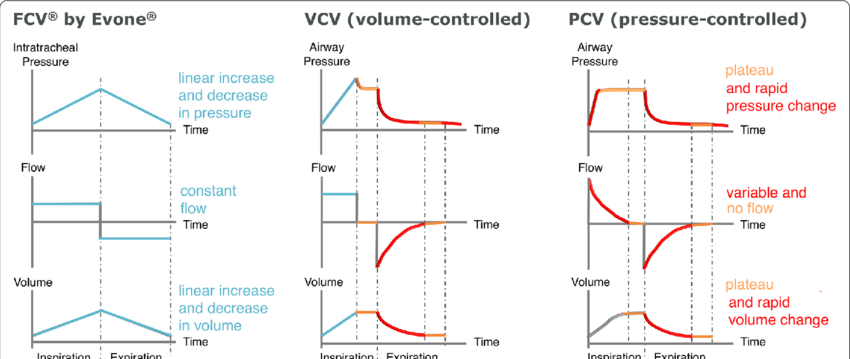
Here is how the flow, pressure and volume graphs of the three modes look:
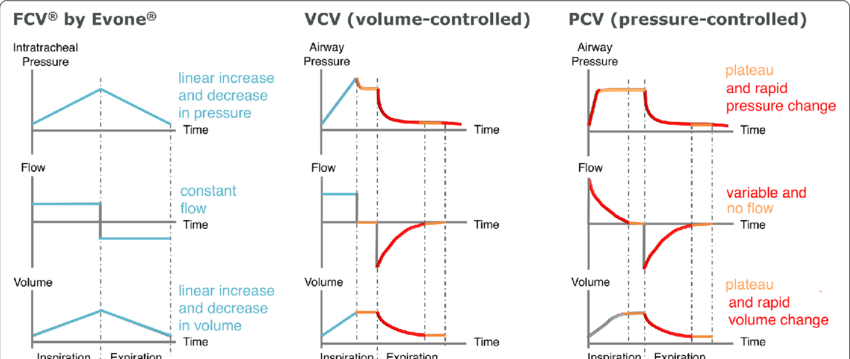
As you can see from the graphs, the gaseous behaviour is remarkably different, more orderly and controlled even, with flow control.
- Volume control has a set flow for a short inspiration, but a chaotic and rapidly decelerating expiratory flow
- Pressure control has a set pressure for inspiration which then suddenly drops away, and the flow seems to be continuously changing throughout the respiratory cycle
- Both have inspiratory and expiratory pauses
Whereas for flow control, it seems much more robotic - steady flow in, steady flow out - with slower, linear increases in pressure and volume.
You could convince me that the graph on the left is less damaging to lung tissue, if only because it is drawn in a reassuring pale blue, rather than inflammatory reds and oranges.
Active exhalation
This is the biggest difference between FCV and the others.
PCV and VCV actively push gas into the patient, and then let it fall passively back out again.
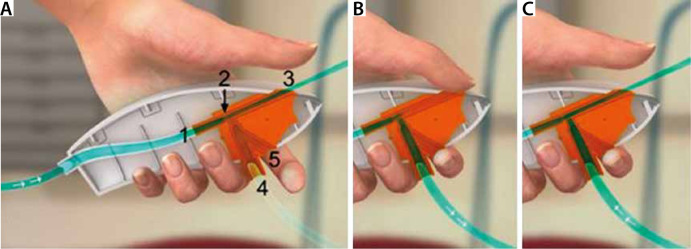
FCV uses controlled active negative expiratory flow, effectively sucking the gas back out of the patient's lungs at a set rate.
Shudder.
Why on earth would we do this I hear you cry, well apparently this provides a nice linear drop in pressure rather than letting the gas escape at whatever rate it so pleases.
The proposed benefits of this are:
- Better end-expiratory lung recruitment
- Less damage to the lung tissue
And from the available evidence it seems to work, well in pigs at least.
And these guys found lower rates of postoperative pulmonary complications after cardiac surgery.
Having read more about it, the best analogy I can think of is this:
- VCV is blowing a balloon to certain size and then releasing it, letting it deflate by itself
- PCV is blowing at a certain effort, for a certain amount of time, then letting it deflate
- FCV is attaching a huge syringe to the balloon, pushing the plunger slowly in, and the pulling it slowly back out again
And the theory goes that this controlled extraction of gas at a set flow is much gentler on the fragile lung tissue.
So maybe it's worth knowing about?
What settings do I use?
There are two principal variables that you control for flow controlled ventilation:
- FiO2
- Flow
That's it.
No tidal volume, no respiratory rate, if you want to clear more CO2, you adjust the flow.
The I:E ratio is also fixed at 1:1, and there is no inspiratory pause, so you might not want to employ this mode of ventilation for your asthmatic/COPD slow exhalers.
You generally adjust the flow by 1 litre increments to achieve the end tidal CO2 or PaCO2 that you want.

So if you're looking to get a minute ventilation of 6 litres/min, you crank the flow up to 12.
The ventilator applies the set flow rate, then looks at the tidal volume that is being achieved, and sets the respiratory rate automatically to achieve the desired minute ventilation.
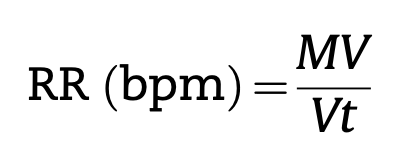
So for example
- You set 12 litres/min flow because you want a MV of 6
- Tidal volume is 600 ml
- Ventilator therefore adjusts respiratory rate to 10
You adjust your FiO2 exactly the same as you would normally.
What about my PEEP and driving pressure?
Put it this way, you're not going to be dialing up your customary PEEP of 7 just to wind your neurotic consultant up.
Instead you now dynamically adjust your PEEP and driving pressures based on the ever-changing compliance of the patient's respiratory system to find the magical optimal PEEP point.
Instead of sticking the PEEP on 5 cmH2O and sitting down, you now stick the PEEP on 5 cmH2O (and the ΔP on 10 cmH2O) and:
- Look at the tidal volume
- If too low, increase the ΔP until the tidal volume is 6-8 ml/kg
- Then increase the PEEP 1 cmH2O at a time
- Peak pressure (PEEP + ΔP) will therefore increase as well
- Wait 30 seconds
- Look at the compliance measured by the machine
- If increasing PEEP heralds increased compliance, continue
- If it does not, then don't (crazy right?)
You can adjust up and down until you find the point where you get the most dynamic compliance.
Then you sit down.
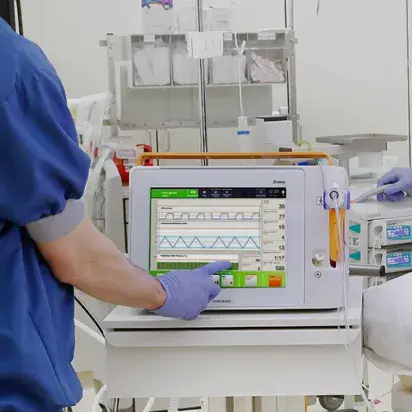
Help, I'm standing in front of an Evone ventilator and need to start using it right now
No way are we taking responsibility for you choosing to use FCV on your own with no training.
However, entirely hypothetically speaking, we might say something like:
- Set flow to double the desired minute ventilation
- Start PEEP at 5 cmH2O
- Start ΔP at 10 cmH2O
- Titrate ΔP to get a tidal volume between 6 and 8 ml/kg
- Then walk PEEP up and down looking for the best compliance
- Remember you're looking at tracheal pressures, not circuit pressures
But again, this is not us telling you what you should do.
When should I use flow-controlled ventilation?
Well to begin with you're going to have to wait until you have access to a ventilator capable of performing flow controlled ventilation.
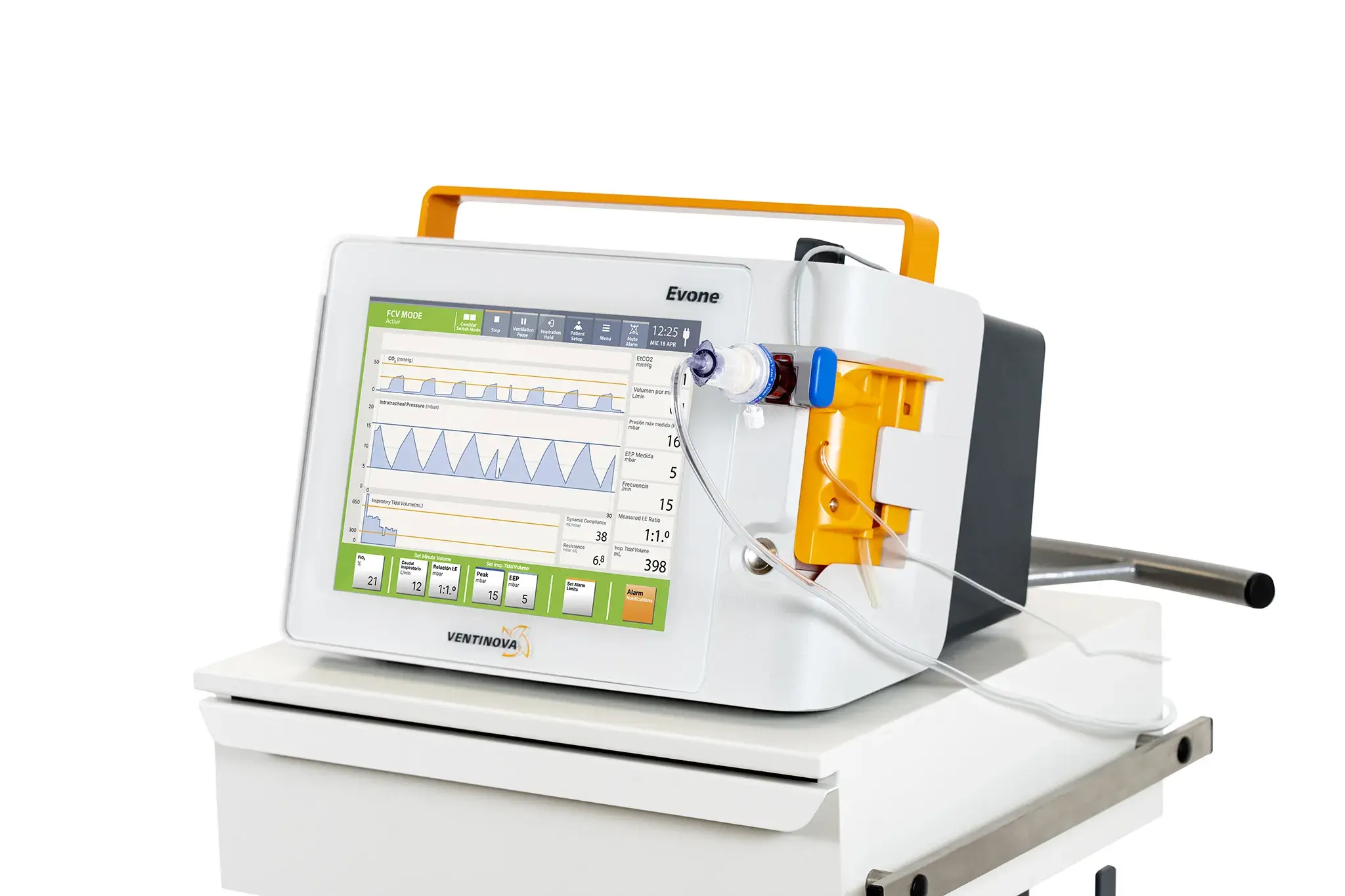
Then you need to think about the supposed benefits of FCV, and when you might want to employ them.
What are the proposed benefits of flow control ventilation?
- More efficient lung recruitment
- Improved gas exchange
- Reduced energy dissipation
- Better ventilation through really small endotracheal tubes
The constant steady flow maintains gentle predictable changes in airway pressure and reduces derecruitment at the end of each breath, and aims to:
- Promote homogeneous lung ventilation
- Avoid regional overdistention
- Improve oxygenation
Essentially it allows you to say 'I want to clear more CO2' and the ventilator then says 'fine, I'll keep it lung protective' or something like that.
I think.
When to consider using FCV
The cases where FCV would theoretically be particularly useful include:
- Bariatric surgery
- Minimally invasive abdominal surgery
- Intrathoracic surgery under one lung ventilation
- Shared airway surgery with tiny MLT tubes
- ARDS in intensive care
The cases in which FCV has been more extensively studied include:
- Tracheal surgery with a very small lumen tube
- One lung ventilation during thoracoscopic lobectomy
- ARDS in intensive care
Situations where you find yourself needing more PEEP and a higher FiO2, and the pressures tend to be higher.
What's interesting is the FCV approach tends to deliver much slower, larger breaths than conventional modes of ventilation.
Aren't bigger tidal volumes less lung protective?
Yes and no.
If you're arbitrarily setting a large tidal volume then that's probably less protective than the standard 6-10 ml/kg formula that we know and love so dearly.
However.
If you're using flow controlled ventilation, and adjusting your driving pressure and PEEP according to the patient's compliance, then the idea is that you're keeping the lung in a state of minimal atelectasis.
This keeps the lung in its most compliant format, between the two inflection points, and therefore you get bigger tidal volumes at lower pressure as a result.
So rather than:
- Big tidal volume means regional overdistension and is therefore bad
it's:
- The lungs are in their happiest, most easily inflatable state, and therefore can safely achieve a larger volume than they would otherwise
If that makes sense?
Why are my airway pressures higher?
Yeah so the airway pressures measured by the ventilator can look higher than you might otherwise see when employing PCV or VCV (or some multiple-lettered patented proprietary combination of the two).
Why?
Two reasons.
Firstly, because the flow is constant, and because you're controlling exhalation as well as inhalation, the end result is that the pressure is being applied much more slowly and steadily.
The end result is in theory more open, aerated lungs ventilating more deeply and more slowly with less work, and in theory this leads to better oxygenation and CO2 clearance, and reduced airway inflammation and postoperative complications.
The answer to whether this actually happens in reality is yet to be discerned.
Secondly, the FCV set up measures the pressure in the trachea, rather than in the circuit, so it's going to be higher as there's much less opportunity for leakage before the pressure gets measured.
How does FCV measure airway pressure?
Differently to PCV and VCV, as you might have guessed.
In 'normal' mechanical ventilation, airway pressures are measured in the ventilator circuit either at the Y-piece or inside the ventilator itself.
This means the measurement includes the loss of pressure caused by:
- Resistance from the tracheal tube
- Resistance from the breathing circuit
Normally not much of an issue, but with a very long circuit and a tiny ENT tube, this can be significant.
For FCV, however, the ventilator measures pressure in the trachea.
Yes - it uses a special sensor that's either built into a presumably exceedingly expensive endotracheal tube, or can be added using an equally expensive adaptor aggressively promoted by the person who brings M&S sandwiches to your departmental audit meeting.
So for X% more money you can say that you're measuring respiratory pressures and compliance Y% more accurately.
One suspects X>Y.
What problems might occur with flow controlled ventilation?
Aside from the human factor issues associated with using a new and unfamiliar technique, there are a couple of specific situations to consider.
What are the drawbacks of FCV?
- Unfamiliar technique
- Needs a compatible ventilator
- Requires mandatory ventilation
- Unsuitable for induction or emergence
- Only works with TIVA
Haemodynamic instability
- Raised intrathoracic pressure impairs venous return and causes cardiac output to drop
- Drop the PEEP and driving pressure
- Give fluid if hypovolaemic
- Consider pressors as you would any other case
Compliance doesn't improve
- Either because you're already at the compliance plateau or there is an intrinsic lung problem meaning recruitment isn't working properly
- Drop the PEEP and driving pressure to see if compliance improves
- If it does, you were probably at the plateau
- If not, it's probably a lung problem that you're not going to fix with ventilator twiddling
Hypoxia
- Increase the FiO2
- Consider increasing PEEP and driving pressure
- Switch back to a ventilator mode that you can actually get to work
Mind blowing stuff.
Patient starts trying to breathe
Yeah they can't be doing that.
- Either due to relaxant wearing off or increased surgical stimulation
- Either deepen sedation, give more muscle relaxant or use opioids to take control again
- Or switch to a different mode of ventilation
FCV only works as a mandatory mode, so you need to take control and stop the patient from breathing spontaneously.
When should I absolutely not use FCV?
- Induction and emergence
- When you want spontaneous breathing
- When you need an adjustable I:E ratio (asthma, COPD)
- When they're haemodynamically horribly unstable
Take home messages
- Flow controlled ventilation uses active expiration with no inspiratory or expiratory pause
- It's a strictly mandatory mode that can only be done with TIVA
- PEEP and driving pressure are dynamic, titrated to compliance, and as a result the lung is supposed to remain in its happiest, most compliant configuration
- The overall reduction in mechanical power is thought to mean less lung damage
References and Further Reading



 Patrick Spraider
Other ventilation posts
 Anaestheasier ltd.
 Anaestheasier ltd.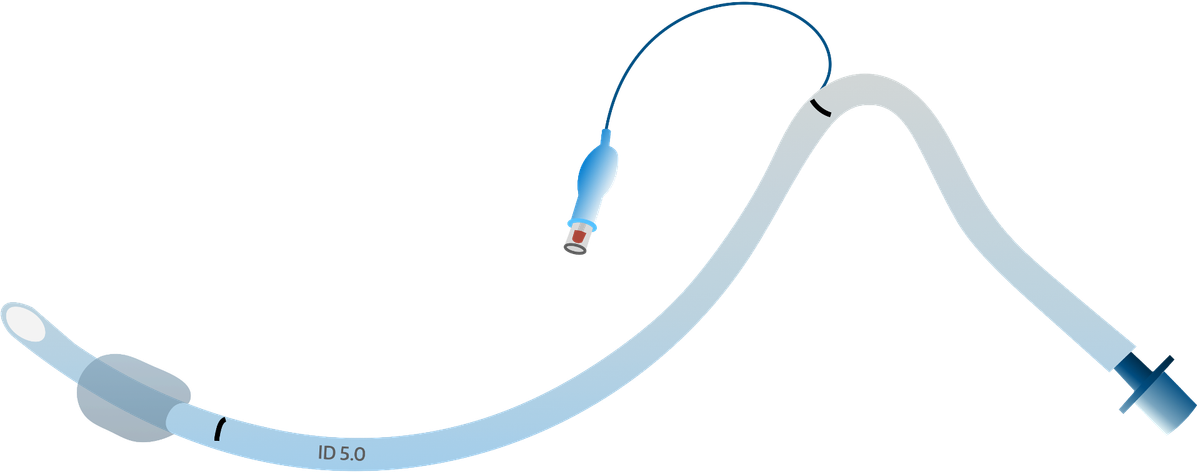
 Anaestheasier ltd.
 Anaestheasier ltd.
Just a quick reminder that all information posted on Anaestheasier.com is for educational purposes only aimed at trained professionals, and it does not constitute medical or clinical advice.
Anaestheasier should not be used as a definitive resource for academic writing, please reference original source material.
Anaestheasier® is a registered trademark.