Guedel's stages of anaesthesia
Picture this
You have a bottle of chloroform, or ether if you prefer, and a patient in front of you.
That's it.
No monitoring, no anaesthetic assistant, not even a wheelie chair from which to sling snide remarks at the surgeon.

Ever since that fateful day on 16th October 1846, anaesthetic practitioners have been trying to safely administer therapeutic doses of wildly powerful hypnotic vapours to their patients in order to spare them the horrors of awake surgery.
Imagine yourself standing there, finger on the pulse of the patient, asking yourself:
- Are they unconscious?
- Are they going to stay still?
- Are they going to be in pain?
- Are they too deep?
- Are they going to stop breathing?
And the only two options you have at your disposal are to administer more, or hold your nerve.
Instead of an end tidal CO2, MAC reading and blood pressure, you had to use your clinical acumen.
Shock horror.
So it's hardly a surprise then, that rather a lot of people died.
Welcome Dr Guedel
Meet Arthur Ernest Guedel (1883–1956), an American anaesthetist who made his name anaesthetising soldiers during the First World War, and went on to develop his famed classification of the stages of anaesthesia in 1937.

To be quite clear, he was not the first anaesthetist to appreciate that as you administer more and more ether to a patient, they tend to progress steadily through different recognisable clinical states (the most recognisable being the final one - death).
What he did was formally classify them with meticulous observations of several physiological parameters, to allow a practitioner to objectively identify where along that spectrum the patient was currently sat, rather than going off gut instinct.
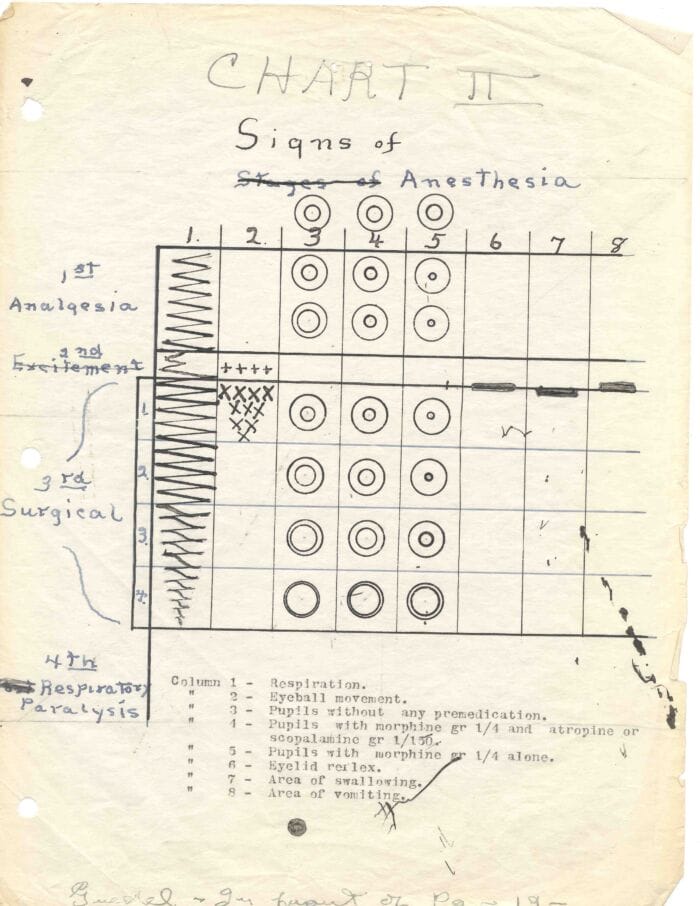
This in turn helped guide them to either administer more, or back off, or call the priest.
This was practically very useful during the War, as it allowed him to train up others to safely administer ether anaesthesia without years of practice to hone those instincts.
Instead they could just follow his chart and get it right every time.
It's a nice physiological map of the journey a patient takes when huffing upon the etherial vapours, as one by one they lose:
- Consciousness
- Cortical function
- Reflexes and movement
- Respiratory muscle activity
- Medullary function
And when you're anaesthetising a patient with no monitoring or equipment to ventilate a patient, it's quite helpful to know how close you are to losing respiratory function.
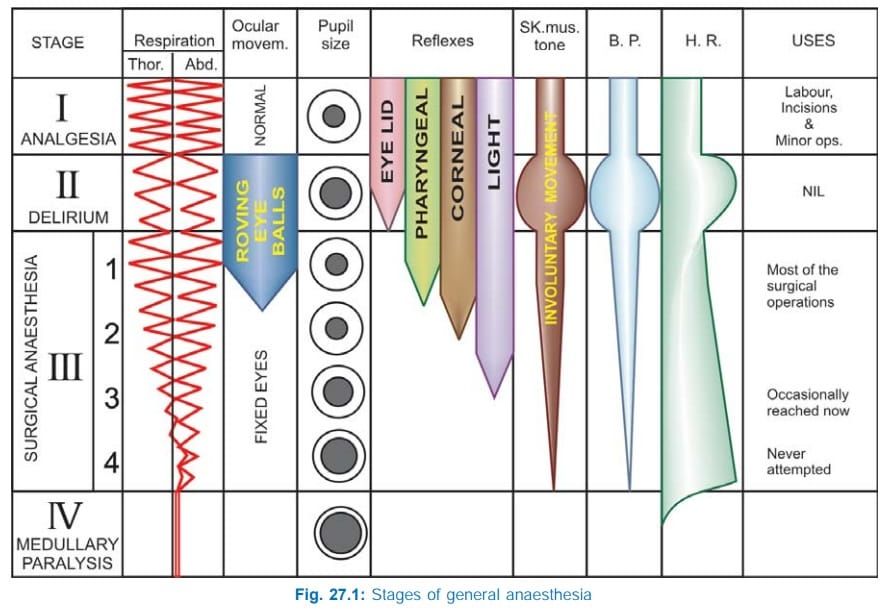
What are Guedel's four stages of anaesthesia?
Starting with the awake, conscious and presumably terrified patient, Guedel described four stages of anaesthesia, with the third stage divided into four planes.

What is interesting, is that ether's relatively gentle effect compared to some of the sledgehammer alternatives like chloroform, made it possible to identify these discrete stages more clearly.
Ether has a blood gas partition coefficient of 12 (compare that to sevo's 0.6 and desflurane's 0.4) which would have made every induction painfully slow.
However this did allow the different stages of anaesthesia to be appreciated in much greater detail, and Dr Guedel may not have been able to produce such excellent data with faster acting agents.
Stage 1
- Analgesia
- Amnesia
- Respiration is generally regular
- Protective airway reflexes intact
This is the level that we aim for with nitrous oxide during labour.
Stage 2
You'll recognise this from those rocky paediatric gas inductions that make you question why anyone would want to be a paediatric anaesthetist.
- 'Excitement'
- Loss of consciousness
- Loss of higher cortical function but subcortical and spinal reflex activity remains very much active
- Irregular respiration
- Breath-holding
- Coughing
- Swallowing
- Vomiting
- Exaggerated reflex responses
- Involuntary movement and struggling
- Increased skeletal muscle tone
- Dilated pupils
- Sympathetic activation
This is the danger zone, similar to the turbulence as a plane ascends through the clouds after take off - leave the airway alone.
Even attempting to cannulate at this point can trigger brutal laryngospasm, so just hold your nerve and try to pass through quietly.
You'll know when you're leaving stage 2, because the patient's breathing becomes steadily more regular and automatic.
Stage 3
This is where we're aiming for, our safe place where we want our patient to sit for the duration of the operation.
One of the reasons we love propofol inductions is because it carries us very rapidly through stages 1 and 2 to 3, avoiding much of the nastiness of the excitable zone.
- Surgical anaesthesia
- Divided into four planes
Plane 1
- Regular automatic breathing
- Eyelash reflex disappears
- Eyes may still move
Technically the patient has now entered surgical anaesthesia, but it may be insufficiently deep for some of the more stimulating procedures.
Plane 2
- Eye movements stop
- Corneal reflex disappears
- Regular respiration
- Increased muscle relaxation
This is probably the ideal plane for most operations.
Plane 3
- Intercostal muscle function deteriorates
- Respiration becomes increasingly diaphragmatic
- Pupils start to dilate
- Pupillary light reflex disappears
This is useful for really stimulating procedures, but probably excessive for most operations.
Plane 4
- Complete intercostal paralysis
- Leading to diaphragmatic paralysis
- Heading towards apnoea
This is uncomfortably deep and heading for danger.
Stage 4
- Anaesthetic overdose
- Medullary paralysis
- Respiratory failure as diaphragmatic function is lost
- Cardiovascular collapse
Death will follow soon after if any further anaesthesia is administered. Support the cardiovascular and respiratory systems as required/able until the patient has exhaled some of the excess vapour.
Or call the priest.
Airway the dog
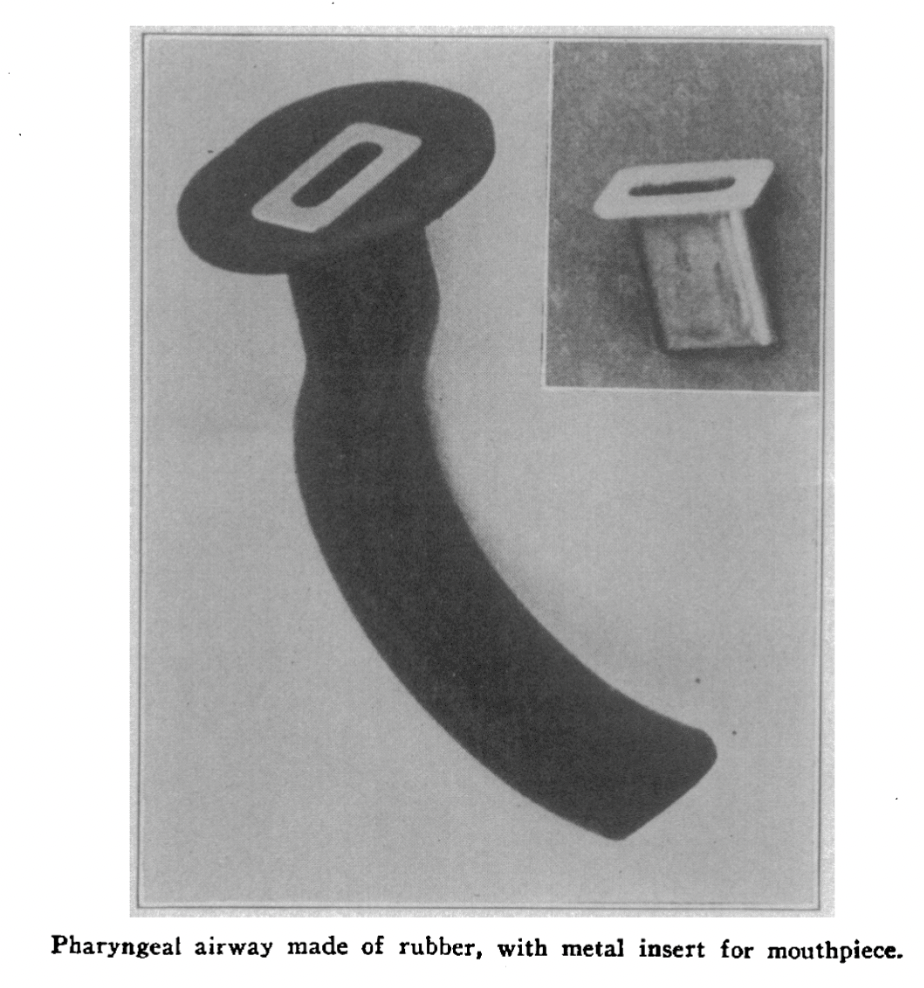
As if he wasn't enough of a legend already, what with his invention of oropharyngeal airways and cuffed endotracheal tubes, Guedel also named his dog Airway.
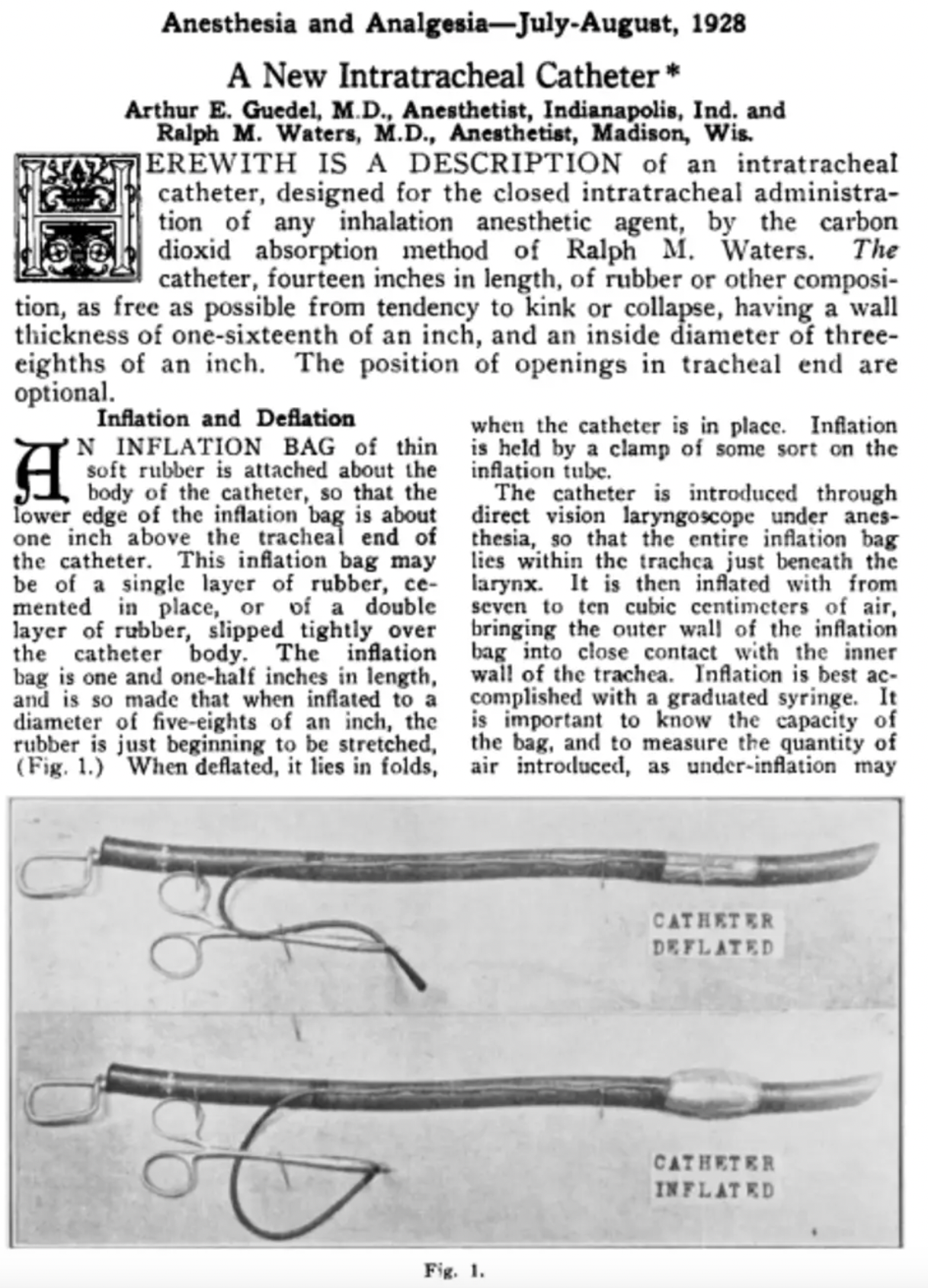
Furthermore, he then used said pooch to demonstrate the efficacy of his own design of cuffed endotracheal tubes, by anaesthetising and intubating the poor mutt before dunking him upside down in a tank of water.
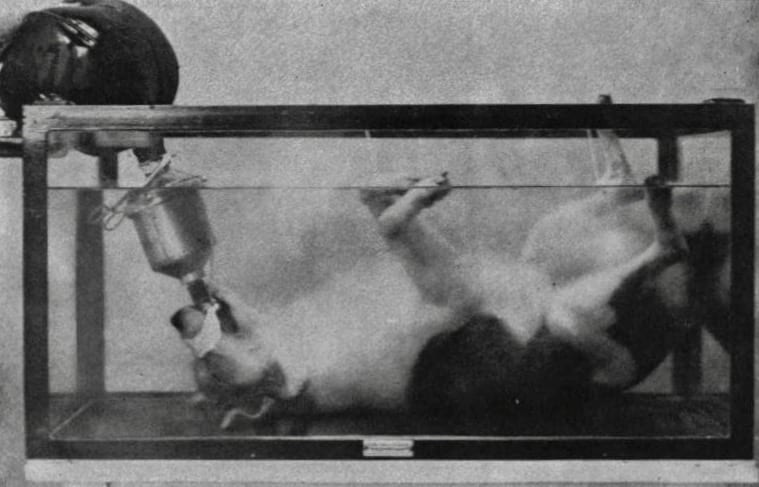
The dog was totally fine, ventilated comfortably for the duration of the demonstration before waking up and walking around the stage a little soggy but perfectly content.
Can I actually use this information?
Well yes and no.
No
No in the sense that this classification describes the physiological changes seen when ether is used as the sole anaesthetic agent, so as soon as you add in opioids, propofol and muscle relaxation, half of the physiological parameters go out of the window.
- Pupil signs will be dominated by opioids
- Muscle tone and respiration will be obliterated by your rocuronium
- Ephedrine is going to blow the heart rate up
Yes
Yes in the fact that there are still times when you actually are only using a sole agent, such as a gas induction for a child with sevoflurane.
In this instance, the child will steadily progress through the stages as described above, and you can use the different signs to decide when it's safe to start putting in cannulas and airways.
- Stage 2 is hopefully fairly obvious on the way down - trying to stick a cannula in now may well trigger laryngospasm and breath holding
- Regular automatic breathing as they enter stage 3 can be seen both by looking at the chest and the capnograph
- Loss of eyelash reflex in stage 3 plane 1
- Loss of corneal reflex in stage 3 plane 2
Stage | What it looks like | What to do |
1 | Analgesia, amnesia, regular breathing, reflexes intact | Continue induction |
2 | Excitement, irregular breathing, struggling, risk of laryngospasm and vomiting | Leave them well alone until breathing is regular |
3 Planes 1 and 2 | Automatic breathing, eyes stop moving, eyelash then corneal reflex lost | Safe for airway manipulation / most surgery |
3 Planes 3 and 4 | Diaphragmatic breathing, pupils dilate | Lighten if appropriate |
4 | Apnoea and impending cardiovascular collapse | Organ support |
You will also see the same progress in reverse when a patient wakes up after sevoflurane anaesthesia, assuming they're adequately reversed and not completely overloaded with opioids.
Anaesthesia isn't just one thing
This is probably the key thing to take away from Guedel's work.
We talk about how deep our patient is, as if that represents a single variable on its own scale, when in reality there are at least five separate components:
- Consciousness
- Amnesia
- Pain
- Immobility
- Autonomic suppression
When ether and chloroform were the only options, then you could either give more, or let it wear off, but that was about it, and these five variables depended on how much you'd given, and the patient's individual susceptibility to the drug.
But modern anaesthesia allows us to manipulate each of these almost independently.
- 2 mg midazolam will provide amnesia but nothing else
- 100 mg rocuronium will sort immobility out, but again, nothing else
- 30 mg propofol might provide amnesia, while 200 mg will provide unconsciousness, immobility and a degree of autonomic suppression but no pain relief
- 200 mcg fentanyl will provide analgesia and a degree of autonomic suppression, but the patient will still be awake and able to move
You get the idea.
So when we ask whether our patient is deep enough, we should probably be thinking instead of 'which of these five parameters need optimising?'
Classically it's a jump in heart rate after a particularly stimulating part of the operation which makes us think 'not deep enough' when in reality the patient is almost certainly unconscious enough, rather this is a combination of pain and autonomic response that needs managing.
So maybe some fentanyl rather than more sevoflurane?
References and Further Reading

Other fun posts
 Anaestheasier ltd.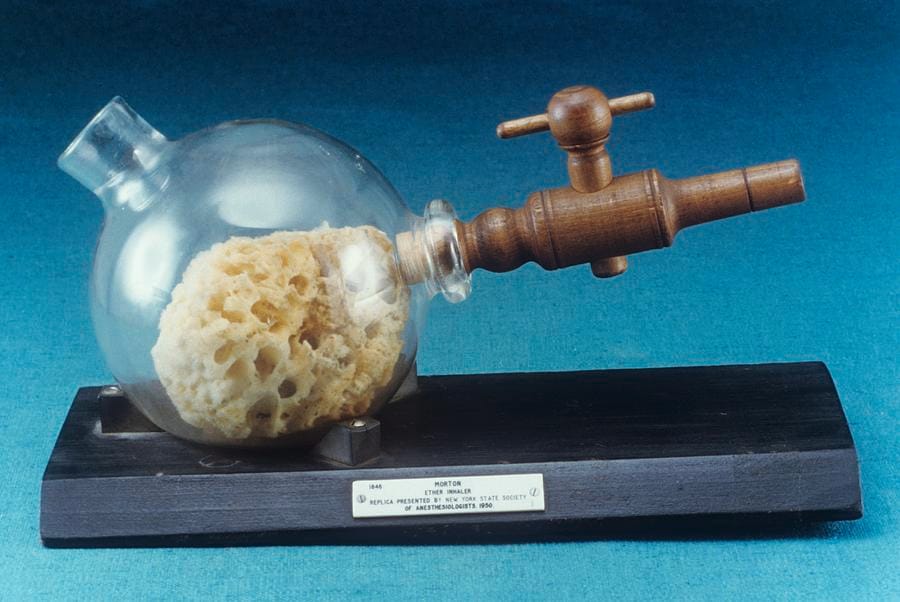
 Anaestheasier ltd.
 Anaestheasier ltd.
Just a quick reminder that all information posted on Anaestheasier.com is for educational purposes only aimed at trained professionals, and it does not constitute medical or clinical advice.
Anaestheasier should not be used as a definitive resource for academic writing, please reference original source material.
Anaestheasier® is a registered trademark.