How to revise for the Primary AKT

The game has changed
From July 2027 the FRCA examinations are changing, and hopefully for the better.
If this is total news to you, or you want to know what exactly is changing, click here.
For today's post, we're focusing on how to smash component #1 - the Primary AKT written exams.
- Two papers
- 80 SBAs each
- 2 hours 20 minutes each
- Online
- Sat on different days
- Paper 1 = pharmacology and physiology
- Paper 2 = physics, data interpretation, clinical measurement, anatomy and statistics
- Performance on both papers is combined to determine pass or fail
Simple enough concept.
The RCoA have emphasised that the curriculum and the expected level of knowledge remains the same as before, but the way in which that knowledge is being assessed will be subtly different.
You can do this
We'll start with some simple reassurance. You can pass this exam.
You know that you're already a master of passing difficult professional exams, otherwise you wouldn't be sat here reading this today.
So think of this as just the next exam on the list, bringing you ever closer to that final exam you'll ever have to take.
- It will require a lot of work
- It will take discipline and focus
- You are absolutely capable of passing it
You just need to commit to the process, and start small.
The first step is reading the rest of this post.
How long do I need to prepare for the Primary AKT?
The question everyone asks is 'how long does it take to revise for the primary?' which is rather tricky to answer as it depends heavily on your situation.
The volume of new information is less than you assimilated in your first year of medical school, the difficulty lies in trying to fit revision around a busy job.
The 'average' time needed to revise for the Primary AKT is around 3 - 6 months but you need to adjust for your own circumstances.
- The RCoA gives a ballpark of 4-6 months
- If you have no other commitments outside work, are in a supportive department, and are able to commit to at least a couple of hours of dedicated revision per day then you can get that down to 2-3 months
- If you have childcare or other responsibilities that mean you can potentially squeeze in an hour every other day, assuming the little one doesn't wake up crying every fifteen minutes, you're looking at more like 6 - 8 months
It also depends on how you study, and what works for you as an individual. If you can absorb and retain information like a sponge by listening to a podcast on your commute, then you will be able to get more done in less time than if you have to be sat down in a quiet room making written notes for anything to sink in.
So start by figuring out how you best study, and when you're going to fit it around your rota and life schedule.
From this you can then figure out how long the process is likely to take.
Cramming won't work
Even if you pride yourself as a veteran crammer, able to crank out an entire anatomy syllabus in eight hours with three cans of Monster and a can-do attitude, the Primary FRCA is going to hurt if you try to employ this approach again.
You might be incredibly talented at absorbing enormous quantities of information in a short space of time, however the issue with the FRCA is that it tests pattern recognition and judgement as much as it does factual recall, and both of these require a certain amount of time to settle in.
Furthermore, you actually need to know this information to do your job properly, so you'll benefit personally from investing enough time and attention to ensure you understand it, rather than just remembering it for the exam.
Start early, take it slow and steady.
Just book it
You never feel completely ready, and there's no correct answer to the question of 'when is the best time to sit the exam?', other than 'before ST4', clearly.
At some point you'll start feeling that internal nudge of 'I should probably start thinking about it soon'.
This is when you should commit, and just book it.
- Not when other people around you are sitting it
- Not when your educational supervisor says 'just get it out of the way'
- Book it when you feel like you have enough breathing space and cognitive bandwidth to commit to at least three months of hard work
Then you just need to take the plunge and book the exam.
Nothing motivates revision quite like the thought of having to spend another few hundred quid on a repeat sitting.
Start with the sample material
The very first thing to do is read through the sample material and exam guidance produced by the RCoA.
- This tells you what you're training for
- It also gives you an idea of where your knowledge needs to be come exam day
Don't read it and think 'oh man I don't know any of this', instead read it and think 'okay, that's what's expected and where I need to get to'.
If you start your revision journey with an understanding of where you need to end up, you'll subconsciously keep track of how you're progressing, and this will provide either reassurance that you're doing okay, or motivation to crack on.
Click below for all of the College's sample materials for the new Primary FRCA exam.

Pick a resource and stick with it
Time for the other question every FRCA candidate asks:
What should I use to study for this famously difficult postgraduate exam?
There are so many options available - videos, podcasts, textbooks, e-learning modules - so how do you decide what to use for your revision?
The short answer is:
- It doesn't really matter
- The material is essentially all the same
- Just find one you like and actually learn it
- Use one primary learning resource, and one question bank
The key thing is not to jump between lots of different resources because you'll just lose track of how much you've done and feel overwhelmed.
A lot of trainees end up collecting enormous quantities of pdfs, textbooks, subscriptions and guidelines, and feel like this constitutes useful work done, when really all it does is cloud your perception of how far you still have to go.
Sales pitch
We're going to come straight out and say that we're heavily biased in favour of our Primary Toolkit, because we built it and so obviously we think it's great.
- It's everything you need in one place
- It covers the whole syllabus
- It's in the right level of detail for the AKT and CASE exams
- It's a live resource, so we can keep it updated
- It comes with an anaesthetic registrar (me) to answer any queries
- It's totally risk free - if you don't like it, full refund no questions asked
It's here if you want to try it:
Okay, sales pitch over.
Try out a few different resources. See which one you feel a natural desire to return to read more. Use that one and stick to it.
Understand your enemy
Once you have committed to sitting the exam, and figured out what resources to arm yourself with, you need to know what you're shooting at.
- If you train by running 5k every morning, and the test is actually a 100m swim, you're going to wish you did things differently come exam day
You can know a lot about anaesthetics and still do very poorly in the exams if you don't understand what is being asked of you.
Recognition vs application
You'll hear lots of people encouraging you to simply smash through as many MCQs as possible for the first written FRCA exam.
This worked for the previous exam configuration, which relied heavily on pattern recognition of questions that had been asked before.
Previous iterations of the exams have used true/false multiple choice questions and single best answer questions that rely heavily on fact recognition, such as:
- Cisatracurium produces less laudanosine than atracurium
- Sevoflurane is primarily metabolised by the hepatic CYP450 2E1 enzyme
If you smashed through enough questions, chances are a load of them will come up nearly verbatim on the day, winning you easy marks.
This is no longer the case.
A large part of why the RCoA have introduced the new exams is because they didn't want candidates relying on pure factual recall, they want to reward anaesthetists who can apply their knowledge to unfamiliar situations.
Because that's our job.
Of course question banks are still incredibly helpful, but simply memorising stems that repeatedly come up is a bad strategy.
The College estimates that around half of each paper will be entirely new questions, so understanding why an answer is correct matters far more than just recognising one you've seen before.
So let's break down the anatomy of the new AKT questions, and figure out how best to attack them.
The anatomy of a Primary FRCA AKT question
Start by reading the question
- Not the stem, the actual question that follows the introductory information
- Each question will start with something like 'which of the following...'
- This will be followed by something like: 'most likely', 'greatest effect', 'best explanation' or 'most appropriate next step'
- This is the most important part of the question, as it determines how you interpret the stem and the different responses
- Read this part first, so you cognitively frame the rest of the stem from the right viewpoint
For example:
"This question is asking me what I should do next, not necessarily the best treatment for the pathology I have diagnosed".
Hence the correct answer is '100% oxygen' not 'administer dantrolene'.
If you look at questions 17 and 18 of the RCoA's sample AKT questions, the scenario is the same, but it's asking different things of the candidate.
Then read the stem
- Usually a short clinical, experimental or conceptual scenario
- It will contain enough information to discriminate between the five options
- Some assess a very specific piece of knowledge
- Others will require several components to be integrated together
Single best answer
- There are five possible responses
- Much of the time, several will be plausible or partly true
- Only one will be better than all of the others
- There will be a specific reason why that response is the best choice
Distractor design
- As with the previous exam format, some questions will have straightforwardly false distractors
- However many of the new questions will have multiple plausible options
- The test is whether you can figure out why one is better than the others
There will be something in the stem that tells you this information, so go back and read it again, and then again.
You should go into each question with the understanding that you may need to rank the responses according to the question being asked, rather than just trying to work out which single answer is the 'correct' one.
This is especially true for the 'what should you do next' style questions.
- A is better than C
- D is better than E
- B is better than A
- A is better than D
Therefore B is the correct answer.
Let's deconstruct an example
A 75 kg 59 year old man has undergone a laparoscopic left inguinal hernia repair under general anaesthesia. He received 100 mcg fentanyl at induction and 15 mg morphine during the procedure. At the end, the surgeons infiltrated 20ml of 0.5% levobupivacaine.
You have extubated him deep, and transferred him to recovery without issue, however twenty minutes later he is difficult to rouse.
His observations are:
- Sats 97% on 6 litres/min via facemask
- Heart rate 70 bpm
- BP 128/66 mmHg
- Respiratory rate 7 /min
Which of the following is the most appropriate next step in management?
- Perform an ABG
- Increase the FiO2
- Give naloxone
- Start non-invasive ventilation
- Reduce the FiO2
Correct answer: Give naloxone
Start by looking at the question - what's the most appropriate next step in management?
So it's not asking for the diagnosis, or the definitive management, just the most sensible thing to do first.
Now look at the stem - what's it focusing on?
The only drugs it has mentioned are analgesia, specifically opioids and local anaesthetic, so the problem is almost certainly related to this.
- You've been told the weight of the patient, so you know the dose of local anaesthetic is safe, making local anaesthetic toxicity less likely as the cause of the low GCS
- Why did the question specifically mention that the surgeon put local anaesthetic at the end?
That's the clue - the patient was showing signs of pain during the procedure, hence was given the 15 mg of morphine, and now the surgeon has put in local anaesthetic and presumably taken the pain stimulus away.
Our patient's observations suggest he is very comfortable, so maybe this drowsiness is due to respiratory suppression caused by the opioids?
The only obviously incorrect response here is to reduce the FiO2.
All of the other options are at least reasonable.
- Increasing the FiO2 won't fix anything as the saturations are already adequate, albeit on a fair amount of supplemental oxygen, but the patient is still very drowsy
- So adding more oxygen isn't going to change the underlying pathophysiological process
- Maybe hypoventilation is the problem?
- Starting NIV is probably overkill as the first step, because you'd want to confirm that the PaCO2 is high and that hypoventilation is the main issue first
- So getting an ABG is a better first action than starting NIV, and would confirm and quantify the degree of hypoventilation, but it wouldn't fix anything
- If you give naloxone, however, you will potentially diagnose and fix the problem immediately
There's information missing here, and deliberately so - if we'd said he had pinpoint pupils the answer becomes immediately obvious - but the point of this exam is that it tests your ability to handle uncertainty and make decisions in the presence of incomplete information.
RCoA example
Consider question 9 from the RCoA's sample pdf:
A patient with a body mass index of 50 kg/m² and no other medical history of note is scheduled for surgery under general anaesthesia.
The ODP has changed his position from semi sitting to horizontal for induction of anaesthesia.
Which of the following is the most important respiratory change that will occur?
- Chest compliance will decrease
- Functional residual capacity will decrease
- Inspiratory reserve volume will increase
- Peak expiratory flow rate will decrease
- Respiratory rate will increase
Answer - Functional residual capacity will decrease.
The first thing to note is that all of these changes are going to occur when you lay an obese patient flat, but the question is asking you which is the most important.
A less compliant chest will be harder to ventilate, but that's not necessarily a huge issue for the anaesthetist just yet. An increased respiratory reserve volume simply means the patient is able to take deeper breaths in if required (because of a smaller starting point), which again isn't particularly an issue right now.
A lower peak expiratory flow may correlate with slower exhalation and lead to breath stacking in extreme circumstances, but for now, not critical, and an increased respiratory rate is going to matter substantially less after an induction dose of opioid with or without muscle relaxation.
A reduced functional residual capacity has immediate life-threatening consequences for this patient, as it reduces their safe apnoeic time dramatically, regardless of how well you preoxygenate them.
This is one reason why we intubate severely obese patients in a ramped or even sitting position, because they have a physiologically and anatomically difficult airway already, so we don't need to add time pressure into the mix.
How to use the Toolkit
We get asked a lot on how best to start tackling the seemingly insurmountable heap of information for the Primary FRCA.
The following section is Will's step-by-step guide on how to get the most out of our Primary FRCA Toolkit for the AKT papers.
As always, this is not the only way to do this, and you'll probably have a good idea in your mind already of how you like to study, this is just a suggestion for if you're unsure where to start.
Step 1 - Start broad and shallow
A common trap people fall into when starting their revision for the Primary FRCA is that they don't know where to begin, so they pick a random topic (usually one that doesn't look too scary) and learn about that.
After fifteen, ninety, or however many minutes your attention span will permit, you sigh and think:
- "I've learned something, and made a bit of progress.
- But there's even more to know about this than I first thought.
- How much of this do I actually need to know, and how am I going to learn this much detail for all the other topics as well?
- And how many other topics even are there!?"
The problem here is going too narrow and too deep too early on in your revision.
The depth and detail for that particular subject is too much to take in at once so early on, and it rapidly becomes overwhelming and disheartening.
So instead, do this first
Open the toolkit up, start top left at respiratory physiology, and just open up the block.
That's it.
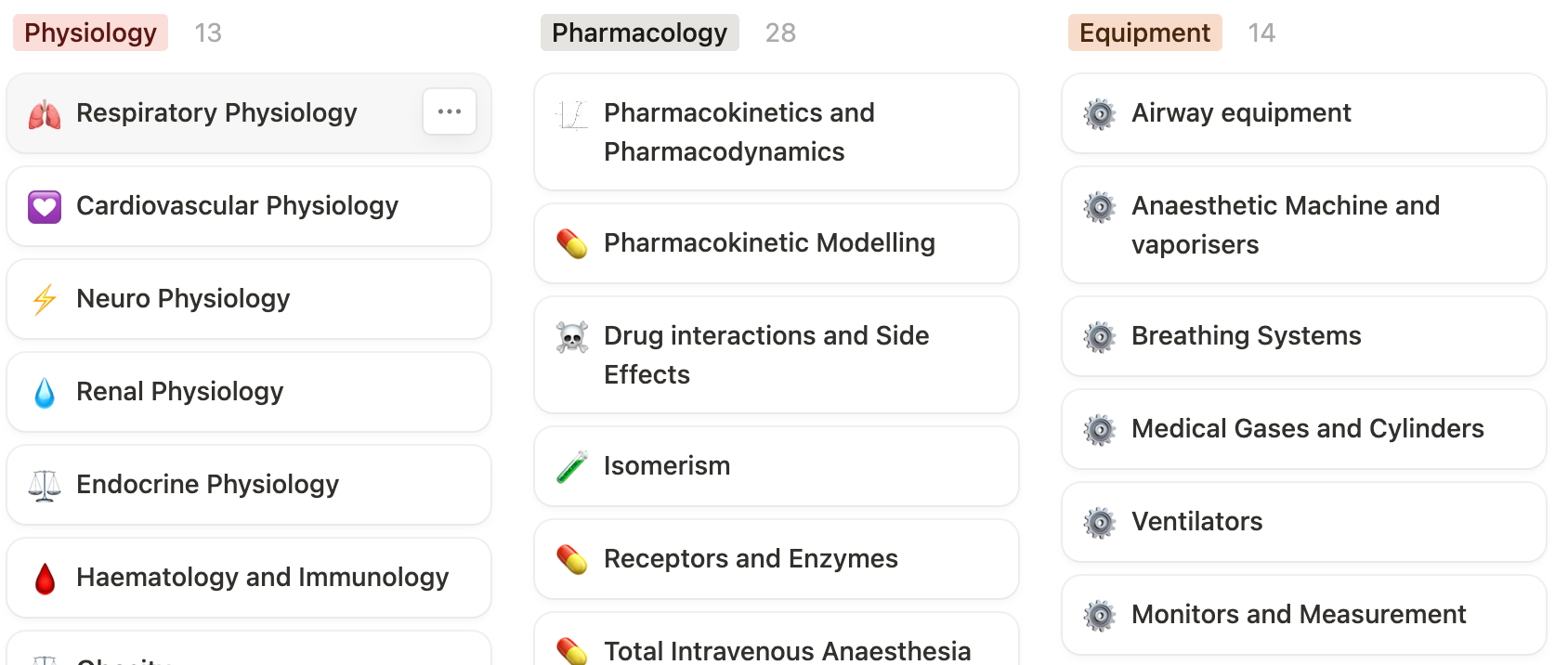
You'll see that there are eight topics in that block to know about.
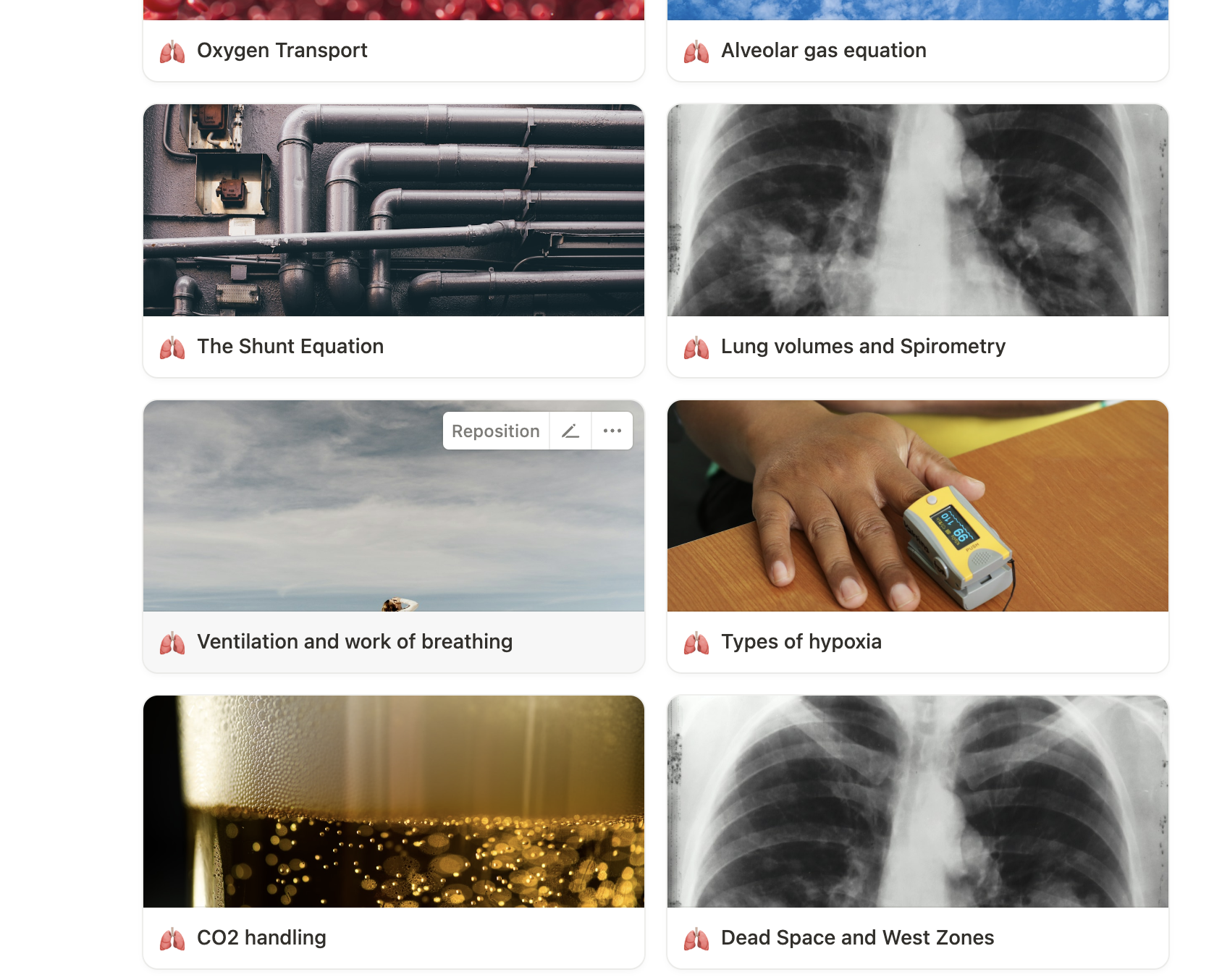
That's it. Stop there.
Just look at the titles, and appreciate the group of topics that you're going to need to cover at some point during your studies.
Do not open any deeper, just go straight back to the main dashboard.
Now do the same for cardiovascular physiology.
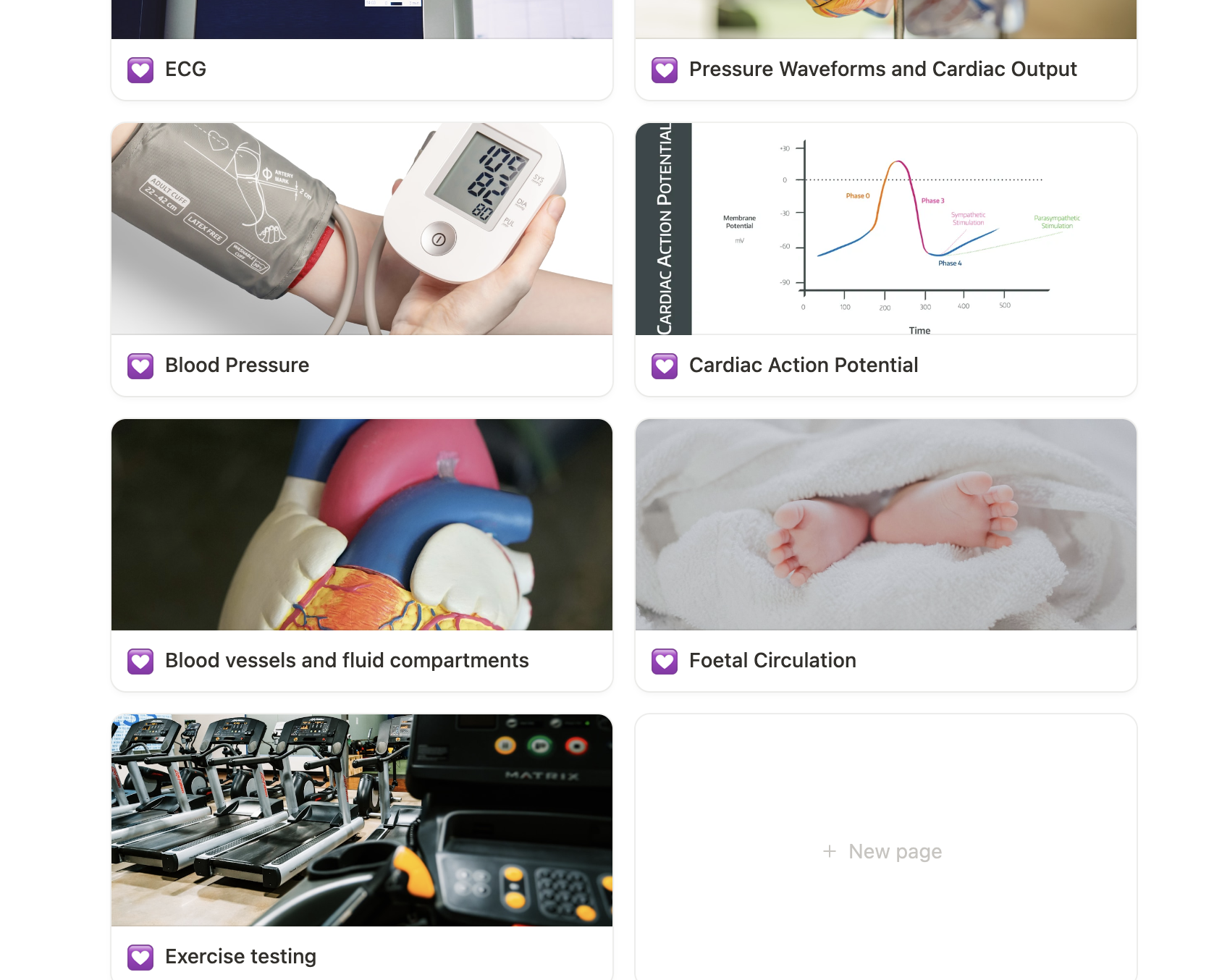
There are only seven this time. Close, and do the same for neuro.
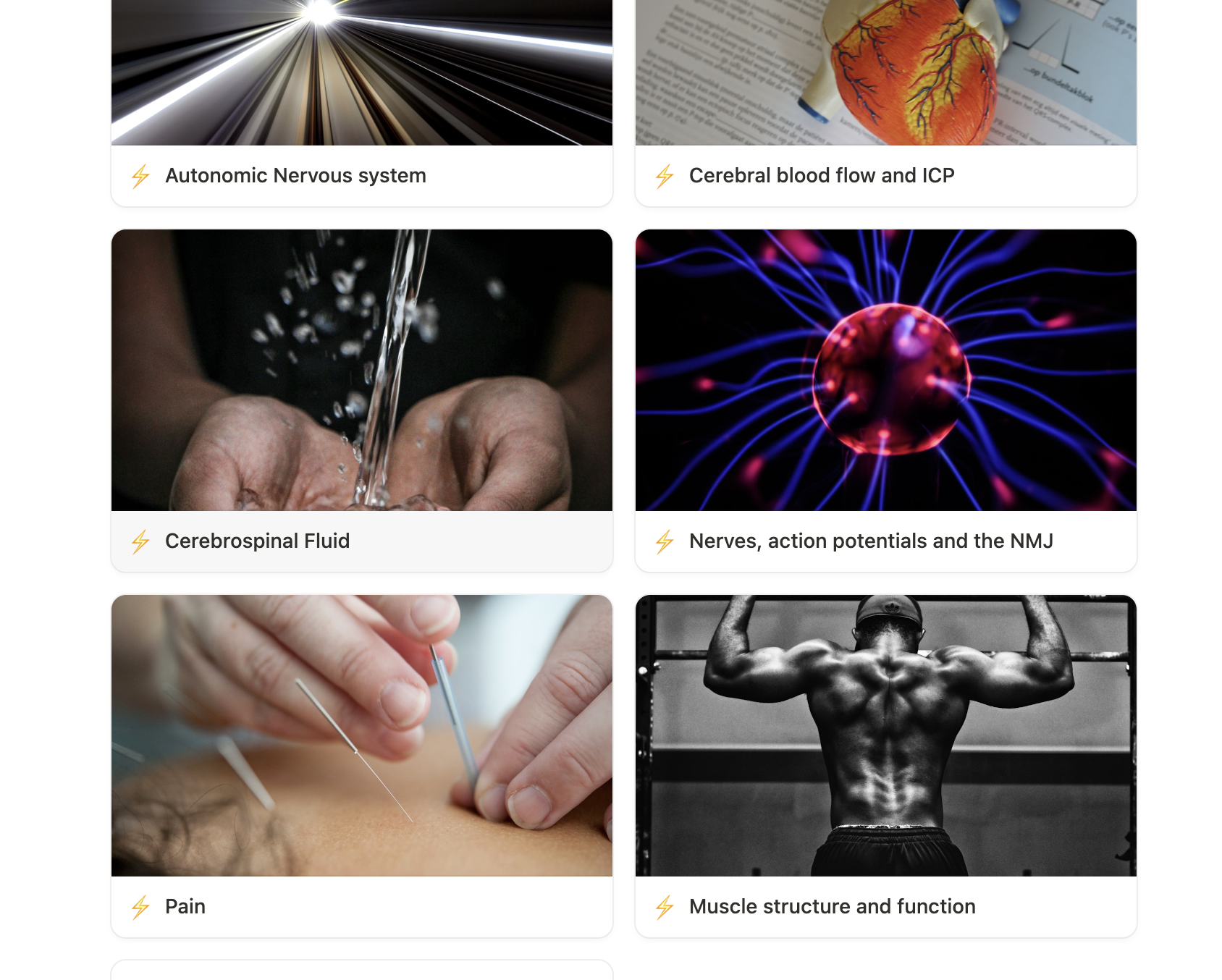
Six.
Continue this process until you have opened every surface block on the main dashboard of the Toolkit, however long this takes.
Now you know how much you need to know.
If you do this first, you will have built an invaluable psychological scaffold on which to pin all of your forthcoming revision sessions.
You have not necessarily learned any new anaesthetic facts, but you have generated an awareness of how far you still have to go, and which topics you still have to cover, which is going to help you out immensely when you're eight weeks away from the exam and starting to fret about what's left still to do.
This is your horizontal scaffold that gives you a grasp of the breadth of the syllabus, and it's the thing people miss out at the start of their exam preparation that causes the most stress later on.
Step 2 - Build your vertical scaffold
Having established a mental model of the different topics that you will need to understand and be able to explain come exam day, you can then start to pick your way through them.
Start with a topic that doesn't look too scary and open it up to reveal the questions.
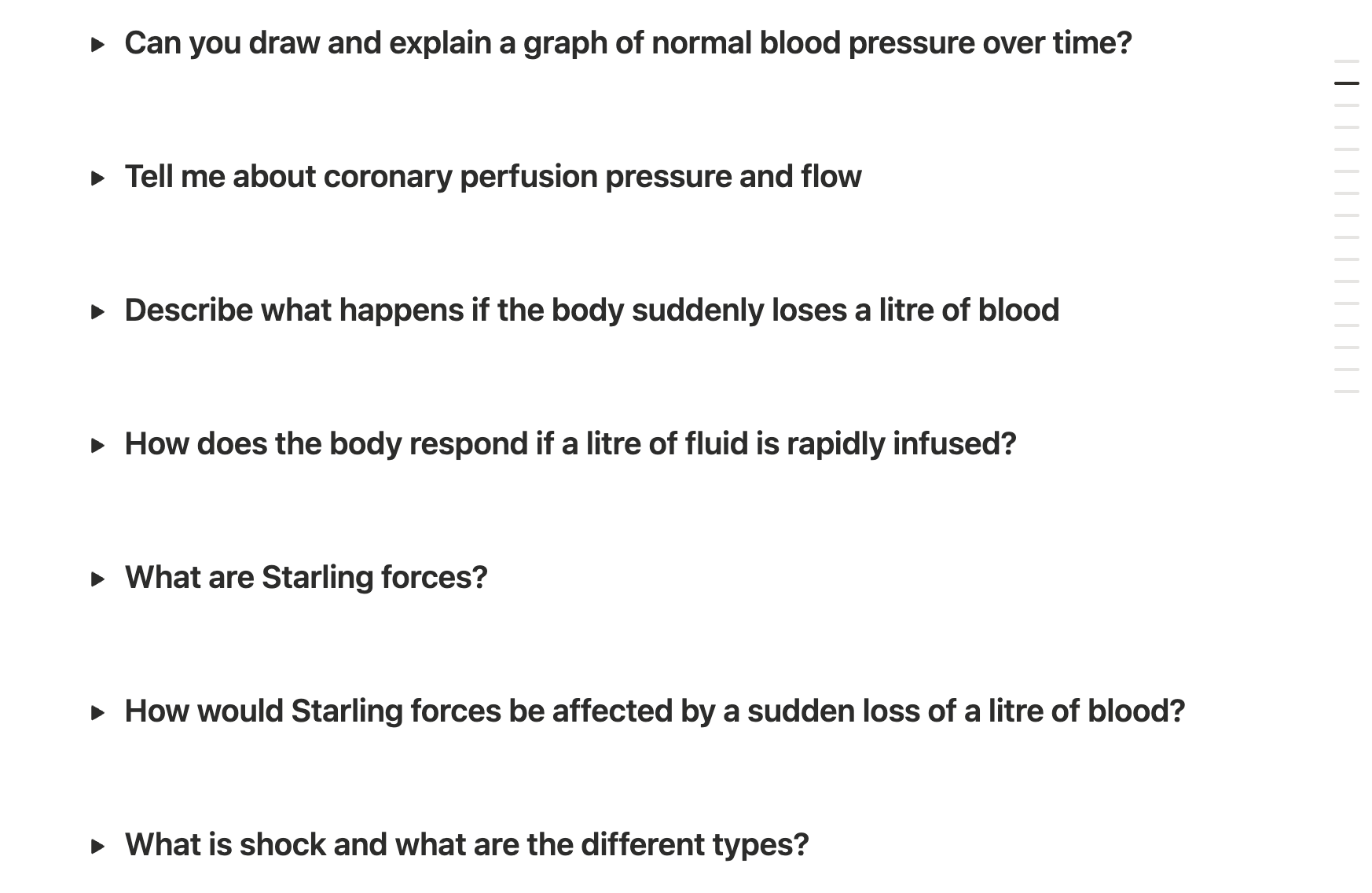
These are the commonly asked questions in the oral components of the examination (previously the SOE, now the CASE) and we've deliberately framed it this way so that as you expand your knowledge base for the AKT paper, you're already doing useful work for the CASE as well.
Once you've opened up the questions, click through the toggles and skim the answers to get a gauge of how much you need to know on that topic.
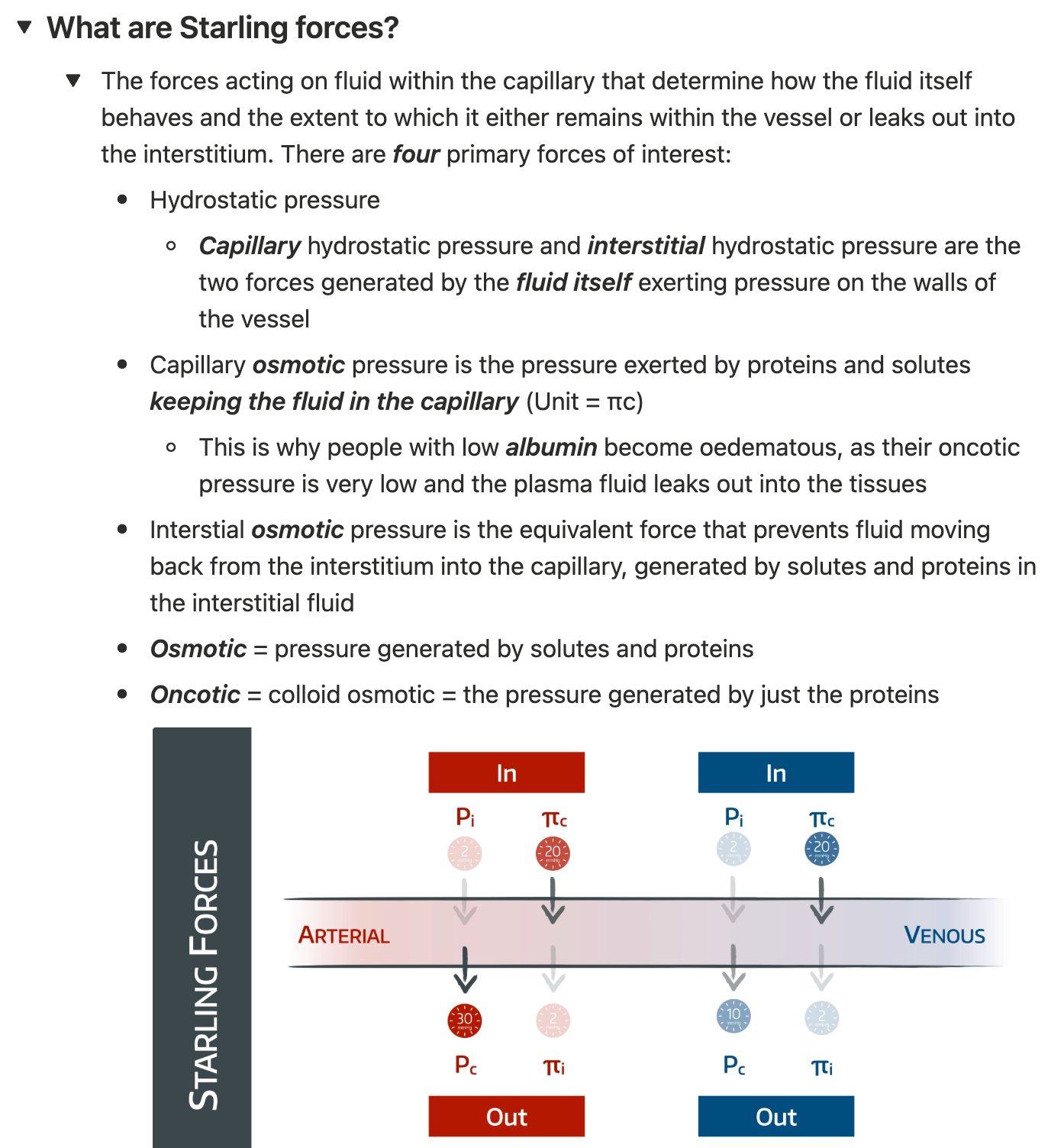
- Do not try and learn anything new
- Just make sure you have opened up all of the questions and answers in that one block
- Once you've read a whole block, close it back up again and take a break
- When you feel ready, do the same with the next block
Again, the point here is not to specifically learn a whole load of new information, you're still in the preparatory phase of building the psychological scaffold upon which to hang your knowledge later.
Completing this process shows you the depth of the syllabus, and once you've completed steps 1 and 2 you'll have a much better idea of how much more you still have to cover when you start your revision proper.
Step 3 - MCQ-guided reading
Some people advocate for immediately smashing through as many questions as possible, to see what the examiners are actually looking for.
Others will say that you need a deeper understanding of the material first, and should read before you start answering questions.
My advice, and the approach I used, is a hybrid model of using MCQs to make your reading much more effective and efficient.
Start by finding a question bank
There are a few to choose from, with the following being the most commonly recommended:
If you're a paid subscriber to Anaestheasier then you already have access to ours here
(None of the above are affiliate links, nor do we have any financial interest in promoting them - they're just the ones people tend to recommend most).
Choose a topic in the question bank such as cardiovascular physiology or physics and equipment, and open the relevant section of the toolkit (or your chosen resource) at the same time.
It's tempting to just crack on with answering the questions, because you'll either prove yourself correct and feel awesome, or receive an explanation immediately.
Instead, we'd recommend this
- Read the question
- Commit to an answer even if you have no idea, but don't click submit yet
- Explain out loud to yourself why you have chosen this answer, even if that explanation is 'I have no idea and this is a guess'
- Look up the answer in the toolkit (or whatever resource you're using)
- Don't stop until you find a satisfactory answer that means you can fairly confidently click 'submit' and get it right
- Click submit
- Read the explanation and reconcile it with what you read before
- Then close your eyes and explain to yourself why the answer is correct, and why the others are wrong
This is how you get the most learning out of each and every question.
Not only does it allow you to cross-check the question bank with the toolkit to ensure they agree with one another, it will show you where in the toolkit that information is for when you need it later.
It's time consuming and feels much less rewarding than 'I completed 40 questions on my commute', but it's worth it. You'll learn the information so much more deeply and efficiently on the first pass and be very grateful you did when it comes to the sitting the CASE.
How deep do I have to know the material?
As a general rule of thumb, if you are able to:
- Explain a physiological mechanism or pharmacological interaction
- Apply this understanding to a new clinical scenario
- Predict what would happen if one variable were to change
Then you're in good standing for this exam.
Let's take question 2 of the RCoA's sample pdf
- If you just memorise that alfentanil has a smaller volume of distribution than fentanyl, it's not going to help you answer this question
- If you understand that a smaller volume of distribution means a faster decline in plasma concentration and therefore faster offset after a bolus dose, then you can potentially answer the question correctly
- If you memorise that higher clearance means faster offset, you'll get the question wrong
- If you understand that alfentanil has a lower clearance than fentanyl, which should make it last longer, but despite this, because its volume of distribution is so much smaller, it is actually faster in offset than fentanyl, you'll get the question right every time
That's the depth they expect from you.
Should I use flashcards?
If you like flashcards, sure.
- They can be an efficient and convenient way to do a bit of 'extra' revision when you have a spare moment between cases
- They're not mandatory
- Only you know how you study best
Just remember that 'number of flashcards completed' is a vanity metric. Being able to explain the answer concisely is what passes exams.
It will feel like it's not sticking
You'll revise respiratory physiology one day, and move onto physics and equipment the day after.
And it will feel like all of the respiratory physiology knowledge evaporates immediately.
This is normal.
This does not mean you wasted your time yesterday. It simply means that this information is complex enough to require multiple passes.
When you revisit respiratory physiology, it will sink in quicker each time until it starts to click.
Don't expect the knowledge to stick on the first go.
Train your endurance
It is exhausting making difficult decisions quickly one after another for hours on end - ask any GP trainee.
But for the Primary AKT you have to make eighty significant decisions in quick succession over the space of 2 hours and 20 minutes.
So you need to train yourself appropriately for this endurance event.
Repeatedly firing off ten questions at a time isn't going to cut it.
As you approach your exam date, make sure you have actually sat down, with no distractions, and done eighty questions under exam conditions at least once before the big day.
You'll notice those last fifteen questions are rather more taxing than the first thirty five purely as a result of having done so much thinking already.
Read the guidelines
This is for the last couple of weeks before the exam date.
You've built your foundation of knowledge, and you've trained your clinical judgement to rank the different responses in the AKT questions.
In the last couple of weeks, check you're up to date with the latest guidelines:
- RCoA
- Resus Council UK
- Difficult Airway Society
- Association of Anaesthetists
These are high yield resources, especially for the 'most appropriate next step' questions, that often get forgotten beneath textbooks and flashcards.
Don't focus on question bank percentages
It's such an easy metric to track, and everyone does it.
What percentage do I need to be achieving to pass?
The reality is that percentages from commercial question banks do not transfer particularly well to Angoff-set College examinations.
- Obviously if you're consistently getting 20% you're unlikely to pass
- And if you're above 80% then you're clearly doing something right
But don't get hung up on the 55% to 70% range of recommendations that get thrown around online.
We're here for you
Anaestheasier isn't just a teaching website, it's a community of like-minded anaesthetists who can share ideas.
We'd love to hear from you with any questions, clarifications or interesting anecdotes that you'd like to share - anaestheasier@gmail.com
We respond to every email personally - no chatbots or auto replies - hence it might take a couple of days, but we promise we'll get back to you.
The Anaestheasier Podcast
We also have a totally free podcast for your commute.
References and Further Reading



Other useful posts
 Anaestheasier ltd.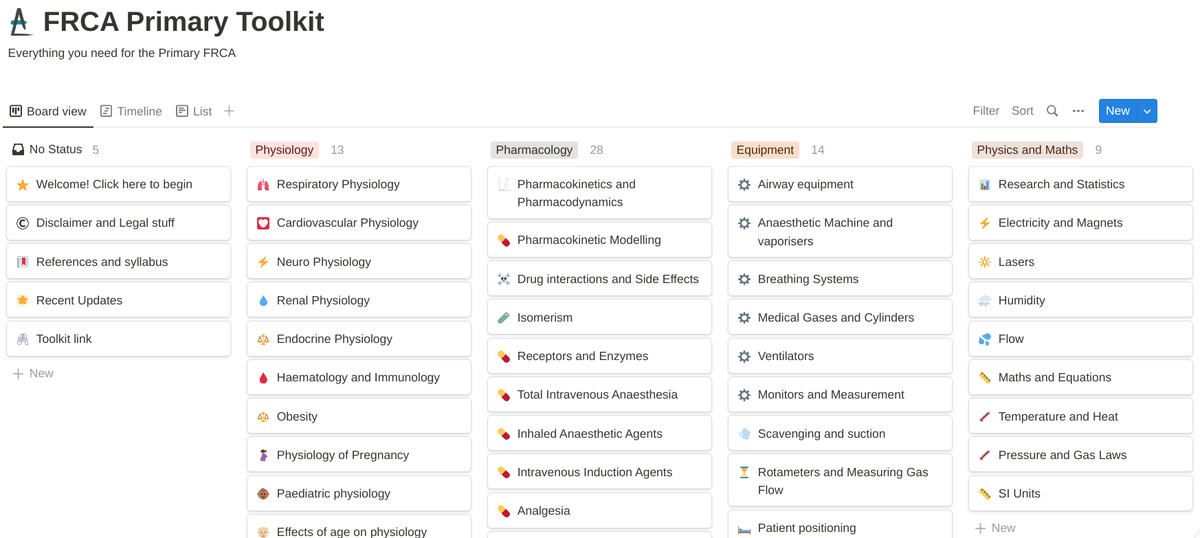




Just a quick reminder that all information posted on Anaestheasier.com is for educational purposes only aimed at trained professionals, and it does not constitute medical or clinical advice.
Anaestheasier should not be used as a definitive resource for academic writing, please reference original source material.
Anaestheasier® is a registered trademark.