Understanding the flozins

A spot of history
Meet phlorizin.
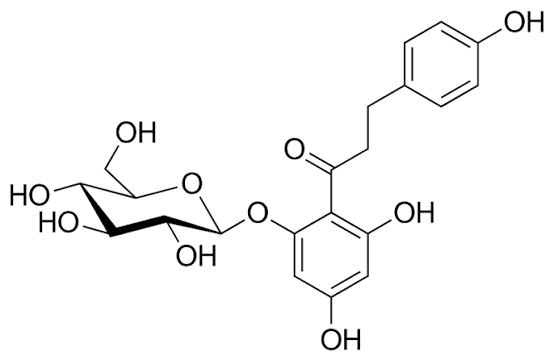
This unassuming molecule was found in the root bark of an apple tree in 1835, and don't worry, you're not expected to know anything about it for the FRCA exams.
Sometime around the 1880s, German physician Joseph von Mering started giving it to animals, and noted they all seemed to behave as if they had diabetes:
- Sugary urine
- Weight loss
- Polyuria
But the key difference that we didn't realise until much later, is this was due to renal glucose handling, rather than pancreatic malfunction.
Phlorizin is a glucoside, (meaning it's a glucose molecule stuck to something else) and it competes with glucose at the SGLT1 and SGLT2 transporters.
It's nature's very own flozin.
However it is also a terrible flozin as not only is it non-selective and knocks out all the SGLT1 transporters in the gut, it gets almost entirely hydrolyzed in the intestine and has minimal bioavailability, hence we now use the much more successful synthetic analogues instead.
But it is the humble phlorizin molecule we have to thank for these game-changing drugs today.
Name the common SGLT2 inhibitors
- Dapagliflozin
- Empagliflozin
- Canagliflozin
- Ertugliflozin
Basically just punch the keyboard and then add 'flozin'.
To properly understand what these drugs are, how they work, and why we should care about them as anaesthetists, we should start with what normally happens in the body.
What happens normally with glucose in the kidney?
Being a relatively small, uncharged molecule of only 180 daltons, glucose is freely filtered at the glomerulus, in proportion to the plasma concentration.
Under normal conditions this is all completely reabsorbed in the proximal convoluted tubule in two steps.
Step 1
- Sodium glucose linked cotransporters (SGLT) use the concentration of sodium to drive glucose up its own concentration gradient
Step 2
- GLUT-facilitated diffusion across the basolateral membrane into the interstitial fluid
- This helps reduce the gradient up which glucose has to travel from the tubular lumen
- Sodium is then pumped out of the cell into the interstitium by the ol' reliable Na/K-ATPase pump
- This maintains the sodium gradient used by step 1
Now this process is all well and good assuming that the blood sugar concentration remains within the normal physiological limits we've evolved to handle, but things start to go wrong as blood sugar increases above 10-12 mmol/litre.
- Around 10-12 mmol/litre, glucose starts appearing in the urine as the kidney's reabsorption mechanisms become saturated
- The TmG or Tmax (the maximal tubular absorption rate of glucose) is around 300-380 mg per minute
- Above 20 mmol/litre the kidneys are completely overwhelmed and all of the additional glucose simply pours into the bladder
Draw a graph to show how renal excretion of glucose changes with plasma concentration
A classic Primary FRCA SOE (soon to be CASE) question with a graph you need to be able to draw on demand.
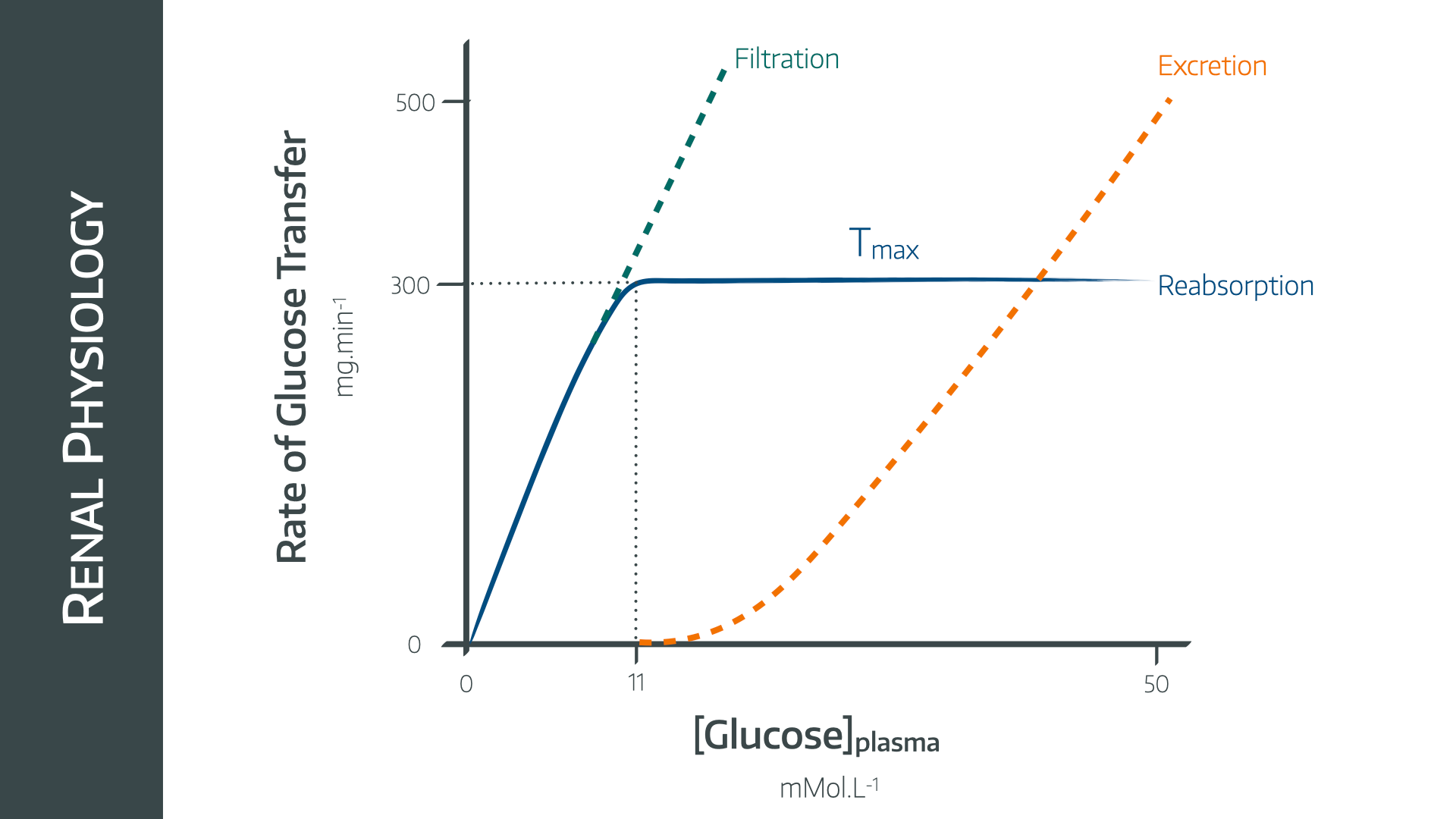
- There is a linear, directly proportional relationship between plasma glucose concentration and the amount filtered, because glucose is freely filtered at the glomerulus
- Rate of reabsorption also increases - initially at the same rate - but then flattens off after 11 mmol/litre plasma concentration as the maximal rate of reabsorption Tmax is reached, which is quoted usually around 300mg/min
- At 11 mmol/litre glucose begins to be excreted in the urine, and this increases linearly once Tmax has been reached, and the rate of increase of excretion matches that of filtration
So how do the flozins help?
It sounds mad, treating diabetes by giving someone all the symptoms of diabetes, but hear us out.
If you suddenly prevent the SGLT2 cotransporter from doing its job, you knock out about 90% of this whole reabsorption process and allow most of the filtered glucose to fall out into the urine, mimicking a state of starvation.
Instead of trying to help the body handle the extra glucose in the blood, you just remove it from the body.
Then you don't have to deal with the hassle and side effects of faffing about with insulin sensitivity and secretion and whatnot.
Sounds like a solid tactic, at least in principle.
But wait.
This is also a major mechanism through which sodium gets reabsorbed in the kidney, so are you not risking hyponatraemia too?
Sort of.
The effect is more sodium gets delivered to the distal convoluted tubule, tickles the macula densa and activates tubuloglomerular feedback. This constricts the afferent arteriole, reduces glomerular hyperfiltration and lowers intraglomerular pressure. We think this is in part how these drugs provide their renal protective effects.
The excess sodium also generates an osmotic diuresis, so by dragging lots of water with it, the end result to worry about is hypovolaemia, rather than hyponatraemia.
Is this a good thing?
Well apparently yes.
The obvious and expected benefits of lower blood sugar and weight loss meant it works well as a diabetes drug.
Yes there's the increased incidence of genitourinary infections (which can be severe) given you've just filled the bladder with lucozade, but if it improves your diabetic control then it's a risk/benefit decision.
But what is more interesting is the unexpected cardiovascular and renal benefits the flozins brought to the table.
- Lower blood pressure
- Less work for a failing heart
- Slower progression of chronic kidney disease
We also think that grumbling along with a very mild hyperketonaemia actually improves cardiac myocyte function by providing an extra fuel source alongside regular glucose.
And these benefits persist even if the patient doesn't have diabetes.
Some exam questions that should now make more sense
Which patients are on SGLT2 inhibitors?
As a result of the above benefits, these drugs have now begun to be widely used in patients with:
- Type II Diabetes Mellitus
- Heart Failure
- Chronic kidney disease
What are the benefits of SGLT2 inhibitors?
- Weight loss
- Lower blood pressure
- Lower HbA1C level
- Cardioprotective in heart failure
- Renoprotective in CKD
What are the adverse effects of SGLT2 inhibitors?
- Increased genitourinary infections
- Increased rates of diabetic ketoacidosis
- Hypotension and hypovolaemia
How do SGLT2 inhibitors cause ketoacidosis?
- SGLT2 inhibitors reduce renal absorption of glucose
- This leads to glycosuria and lower blood sugar
- This reduces insulin secretion
- Cells then require another source of energy, which is usually ketones
- Glucagon levels rise as insulin decreases and blood sugar drops
- This liberates free fatty acids from adipose tissue
- These are carted off to the liver where they are converted into ketones
- This can result in a profound ketosis and raised anion gap metabolic acidosis if allowed to continue unchecked
The key point is that in normal fasting, this process happens slowly enough for the body to adapt, however when it is chemically induced by a flozin molecule, and accelerated by fasting plus the surgical stress response, it happens so quickly that the body cannot adapt quickly enough to handle the influx of ketones and a metabolic acidosis develops.
Why does an anaesthetist need to know about it?
The short answer is euglycaemic diabetic ketoacidosis.
The longer answer is as follows.
We're trained at medical school and beyond to spot and recognise that a diabetic patient with the following triad:
- Hyperglycaemia
- Metabolic acidosis
- Ketonaemia
Is really rather unwell and urgently needs a very specific treatment protocol to be instigated.
If we remove the 'diabetic patient' and 'hyperglycaemia' from this presentation, it's not quite so obvious what's going on.
By pouring their circulating blood glucose down the toilet, patients taking flozins can become significantly ketonaemic as they attempt to replace the lost fuel with something else, in the same way a Type I Diabetic who can't access the circulating glucose would.
The next issue arises when we add in the stress of an operation.
The surgical stress response
You've got a patient taking a flozin, who needs an operation, so what do you do?
- You make them stop eating
- So they urinate out their remaining carbohydrate stores
- Lipolysis kicks in
- Ketone levels rise
The surgical stress response accelerates this process dramatically thanks to the surge in catecholamines and sympathetic activity.
How is it going to catch me out?
Picture the following scenario:
You are asked by the recovery nurse to come and review a post-op patient who is:
- Tachycardic
- Tachypnoeic
- Nauseated
- Dehydrated
- Looks 'off'
They're not in pain, they've had lots of antiemetics already, and a decent amount of fluid during the procedure.
What's going on?
So you do what we all do to buy time and look busy - you get a blood gas.
The CO2 is rather low, the Hb is fine, lactate maybe a little raised but nothing exciting, and the glucose is normal.
But the base excess is weirdly low.
Is your first thought going to be 'maybe this is euglycaemic DKA caused by dapagliflozin'?
Because you're doing better than us if it is.
How do I manage it?
- Treat it as DKA
- Fixed rate insulin infusion
- Glucose infusion to maintain normal blood glucose level
- Fluid resuscitation
- Electrolyte replacement
Then think about the other effects as well:
- Dehydration
- Hypotension
- Hyponatraemia
Not all of the problems in recovery are pain and hypoventilation.
How can I mitigate the risks of flozins?
- Keep fasting to a minimum
- Ensure patients are well hydrated
- Monitor glucose and ketones
- Consider glucose infusions to reduce ketone production if prolonged fasting is unavoidable
What am I supposed to do with flozins before surgery?
You are supposed to look up the latest guidelines on what to do with flozins before surgery, because apparently the rules change every fifteen minutes.
The pharmacokinetics that matter
- Half life of around 12 hours
- No active metabolites
- Pharmacodynamic effect on glucose excretion lasts for up to 72 hours
So even if you stopped the drug 24 hours ago, and only 25% of the circulating molecules are still in the plasma, there will still be significant renal glucose loss going on for a while to come.
On the other hand, if your patient is taking a flozin for their heart failure, and you stop it for three days before surgery - is it going to make their heart failure worse?
The short answer is we don't really know.
The cop-out answer is 'a patient needs an individualised multidisciplinary management plan to optimise their pre-operative medical management'.
The Association of Anaesthetists' current stance is as follows:
- Sodium-glucose cotransporter-2 inhibitors should be omitted the day before and the day of a procedure
- Stick to standard fasting guidelines but avoid prolonged fasting where possible
- Day surgery patients should restart their flozin once they're eating normally (around 24 hours later)
- Inpatients should restart them when eating normally and capillary ketones <0.6 mmol/litre
- Patients with diabetes on special liver-reduction diets should stop their flozin when the specialist diet starts
This aims to be a safe-but-pragmatic approach to ensuring you're not putting patients at undue risk, but you're also cracking on and actually getting their procedure done as well.
References and Further Reading
 Joel R L Ehrenkranz

Other kidney posts
 Anaestheasier ltd.
 Anaestheasier ltd.
 Anaestheasier ltd.
 Anaestheasier ltd.
Just a quick reminder that all information posted on Anaestheasier.com is for educational purposes only aimed at trained professionals, and it does not constitute medical or clinical advice.
Anaestheasier should not be used as a definitive resource for academic writing, please reference original source material.
Anaestheasier® is a registered trademark.