Paediatric Sedation

"Hi there it's the ED registrar, I wonder if you could help me."
'Sure, go ahead.'
"I've got a six year old, fit and well, no allergies, with a distal radial fracture that needs pulling, can you help with sedation?"
This shouldn't feel comfortable
Sedation is the trickiest bit of anaesthesia.
When the patient is wide awake during regional anaesthesia, they're in control of their airway and breathing, and you can talk to them to reassure them when they stress out.
Under general anaesthesia, you're in control of their airway and breathing, and you can give more as needed, knowing that it doesn't matter if they obstruct or stop breathing, because issue is already being managed.
During sedation, no-one is really in control. You're stuck in this no man's land of:
- conscious but not really responding
- breathing but not normally
- snoring a bit sometimes but not tolerating a jaw thrust
And that's before you add any cardiovascular shenaningans into the mixture.
Sedation is difficult.
Then on top of that, it's a child as well, which means difficulties with understanding and capacity, communication and compliance and managing parental anxiety as well.
And to top it all off, you're outside the safety of theatres working with unfamiliar staff in a noisy environment that may or may not have the required equipment and drugs immediately available.
So please don't feel bad if the thought of sedating a child in ED fills you with at least a mild sense of trepidation.
That means you're paying attention.
Things to consider
So what do you need to think about before you slug a load of sleepy juice?
Does this kid actually need sedation?
- The role of sedation is to reduce the distress during a painful procedure
- It is not a replacement for adequate pain relief or local anaesthetic
- Local anaesthetic gel, analgesia and lots of distraction can often obviate the need for sedation and the risks it entails
If they definitely do need sedation, how much are we talking?
Is this to put in a cannula, get an xray, or pull a very painful elbow dislocation?
Sedation is a spectrum, and you need to know where you're aiming.
Can this kid have sedation?
You need to treat this as you would any anaesthetic, and perform a thorough preoperative assessment.
History
- Previous anaesthesia with or without adverse reactions?
- Any medical problems or medications?
- Any significant surgical history?
- Any allergies?
- Last food and drink?
- Any active respiratory tract infections?
Examination
- Well child?
- Snotty and feverish?
- Any airway concerns?
Make sure you're happy that the child is safe to have an anaesthetic, no matter how brief the procedure is expected to be.
What are the contraindications to procedural sedation?
Remember contraindications are always broken down into absolute and relative.
Absolute
- Lack of trained staff
- Inability to manage airway safely
- Parent or competent child refusal
Relative
- Active asthma
- Less than 1 year of age
- Airway abnormality
- Substantial cardiac comorbidity
- Any procedure in the mouth or pharynx
- Recent head injury with drop in GCS
- Intracranial hypertension
- Intraocular disease
- Uncontrolled epilepsy
- Porphyria
- Thyroid disease
- Previous problem with sedation
- Procedure expected to last more than twenty minutes
Are you doing this on your own?
- The short answer is no
- If you're a core trainee anaesthetist, it is very unlikely that your consultant would expect you to independently sedate a child in the emergency department
- If you are a registrar then you may be perfectly capable of safely and competently sedating this child, but you probably want a second set of hands available for good vibes
I have seen many consultants ask for a junior to accompany them to do a paediatric sedation, simply because a second set of airway trained hands is enormously reassuring to have.
Where are you going to do this?
Sedation should only be performed in a resuscitation bay or high dependency area with immediate access to resuscitation equipment and medication.
So essentially it's a choice between resus and theatres.
- Can you get this done safely in resus, avoiding all the hassle and delay of transferring to theatre?
- Is the orthopod going to decide halfway through that actually they need to put in some wires, and so could we just give a 'little bit' of muscle relaxant?
- Does this kid actually need a full GA so the surgeon has full remit to explore a wound and put some metalwork in?
If it's a simple pull-and-cast job, then resus is fine.
If there is any doubt about what the surgeon actually needs to do, then this should be a general anaesthetic in theatre.
Do you have reliable IV access?
- If yes, then fantastic
- If not, how do you plan to get some?
- Ask the nurses to slather on some ametop or equivalent
- Ask the parents how you think the kid will be with you putting a cannula in
If you're finding yourself thinking about how you're going to sedate a child before putting a cannula in, you should probably be thinking about doing a fasted gas induction in theatre instead.
What monitoring is needed?
You need to be treating this the same way you would a general anaesthetic.
- Heart rate
- Blood pressure
- Oxygen saturations
- Respiratory rate
- Capnography
An upset child might not let you get much monitoring on before you start, but you need at least a sats probe and capnography before you inject anything, and then immediately get the rest on once they've calmed down.
What are you going to use?
You have a variety of options available.
- Ketamine - you'll need IV access and prepare for drooling
- Propofol - you'll need IV access and prepare for apnoea
- Nitrous oxide - the kid will need to tolerate the mask
- Midazolam - you'll need IV access and prepare for apnoea and paradoxical agitation
What's your plan for when it goes wrong?
We're professional catastrophisers, and we refuse to apologise for that.
Our job is to think 'what do I do if this all goes wrong?' and to be prepared for any eventuality.
- Airway obstruction - jaw thrust, adjuncts, Mapleson C circuit, Igel, tube, suxamethonium immediately available
- Hypoventilation - oxygen, Mapleson C, face mask, EtCO2 monitoring
- Bradycardia - atropine
- Hypotension - IV fluid, pressors
- Agitation - another form of sedation nearby
- Regurgitation - suction, airway equipment, RSI drugs
Calculate your doses of emergency and resuscitation drugs before you start.
What are your emergency drug doses?
- Atropine 20 mcg/kg for bradycardia
- Suxamethonium 1.5 mg/kg IV or 4 mg/kg IM
- Adrenaline 10 mcg/kg arrest dose (0.1 mL/kg of 1:10,000)
"Should I give atropine or glycopyrrolate to reduce secretions before ketamine sedation in kids?"
Nope. The evidence suggests this may even increase rates of laryngospasm and other adverse events, so just keep it simple.
How does ketamine work?
Ketamine is a strange drug that is absolutely brilliant when used properly.
- NMDA receptor antagonist
- Produces a dissociative state of anaesthesia*
- Powerful analgesic and amnestic agent
- Maintains airway reflexes
- Sympathetic stimulation maintains blood pressure and usually causes tachycardia
*The patient's eyes may stay open as they stare into the K-hole abyss into which you have sent them.
The trend of giving a prophylactic benzodiazepine at the same time has gone out of fashion, due to increased adverse events when compared with ketamine on its own.
If the child experiences significant emergence delirium then 0.05-0.1 mg/kg midazolam is a sensible plan.
Top tips for ketamine sedation
Your department almost certainly has a bespoke 'how to sedate kids in our hospital' protocol, which you should follow.
If not, then here are some sensible tips:
- The standard dose is 1-1.5 mg/kg
- Top up doses are usually 0.5 mg/kg
- Inject slowly over a minute to reduce laryngospasm and apnoea
- Be patient, allow at least 60-90 seconds before assessing whether the patient is adequately sedated
- You're looking for horizontal nystagmus and loss of response to voice as your cue to tell the orthopod to get started
- You can use IM (2-4 mg/kg) in certain emergency scenarios to allow you to get IV access, but you really don't want to be doing this as a junior on your own
- Tell the parents they can take up to two hours to fully recover from sedation
After ten minutes or so, the patient may give a deep sigh or yawn - this is an indication that they are starting to lighten, and you need to decide now whether further sedation is needed, or you're ready for them to return to planet Earth.
Do they need to be fasted?
Of course your life as the anaesthetist is always easier with a fasted patient, so if a patient can be fasted before you give them any sort of sedation that's clearly the preferable choice.
However.
There is balance to be struck between risk of regurgitation under sedation, and timely management of a painful injury in a distressed and agitated child. The sooner you get this done the happier everyone is going to be.
"She had a bite of sandwich and some squash in paeds ED while waiting to be seen."
'Of course she did.'
So what do you do?
Do you say to wait six hours to meet the fasting guidelines, or do you throw caution to the wind and crack on?
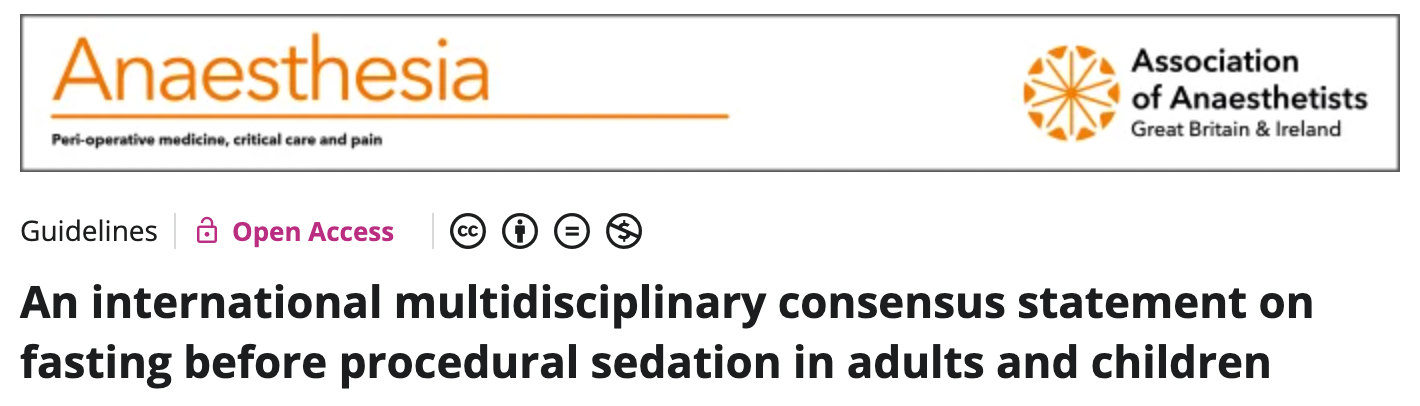
Multiple studies have found that the risk of aspiration under ketamine sedation is sufficiently low that you don't need to wait for the child to be fasted, and in the process you save them the agitation of being hungry and in unnecessary pain for even longer.
Check out this consensus statement for more details.
How would you prepare the parents?
You need to make the following very clear:
- This is not a full general anaesthetic
- They may still make noises and respond, and that's okay - they won't remember it and they're not 'feeling' it in the way they normally would
- Their eyes may stay open if using ketamine - this is entirely normal
- The child may be woozy, confused or strange for a while afterwards, and that's okay
How would you manage laryngospasm?
- Tell the orthopod to stop
- Call for help
- 100% oxygen
- Gentle suction of any visible secretions
- Jaw thrust and Larson's manoeuvre
- PEEP and manual ventilation with Mapleson C
- RSI
Some posts to make you feel better
 Anaestheasier ltd.
 Anaestheasier ltd.
 Anaestheasier ltd.
Sitting the exams?
We've got you covered.
The Toolkits
Everything you need to smash the exams, all in one place.
References and Further Reading
Tadgh Moriarty


Just a quick reminder that all information posted on Anaestheasier.com is for educational purposes only aimed at trained professionals, and it does not constitute medical or clinical advice.
Anaestheasier® is a registered trademark.