Sustainability

Most would argue that since you don't need to know much more than 'don't chuck stuff away if you can avoid it and use low flow where possible' to be a perfectly proficient consultant anaesthetist, it is simply baffling that the examiners in FRCA land would dedicate entire CRQ questions to this topic.
However since they have done this, we thought it prudent to arm you with some factoids that might come in useful.
Choosing those factoids was rather tricky, given this is an endlessly large topic that steadily relates even less to the practice of anaesthesia the further down the rabbit hole you go, but no matter.
Let's dive in, and heads up, this is not a very happy post.
Deep breath
Here we go.
Humans have fairly unequivocally demonstrated themselves as being terrible for the environment in a variety of different ways, with carbon emissions being just one of them.
- If you only look at healthcare, you're already looking at 4% of the carbon emissions worldwide
- If 'healthcare' were a country, it would produce the fifth highest carbon emissions worldwide
- If the NHS were a patient on a ventilator with a respiratory rate of 12, it would have an end tidal CO2 of 3.96 tonnes
The last one is probably not examinable material.
Burn baby burn
The NHS incinerates nearly half of the waste it produces, and only manages to recycle around 15%.
Then COVID came along and plastic PPE waste shot up nearly four-fold in a number of countries.
What are the benefits and drawbacks of incineration of medical waste?
The good bits
- Gets rid of waste
- Destroys pathogens
- Generates electricity
The bad bits
- Huge amounts of air pollution*
- Wastewater and toxic run off
- Ash (which is still around a third of the volume) gets dumped in landfill
*This increases cancer, COPD and cardiovascular disease in the areas surrounding incineration plants.
And then there's us
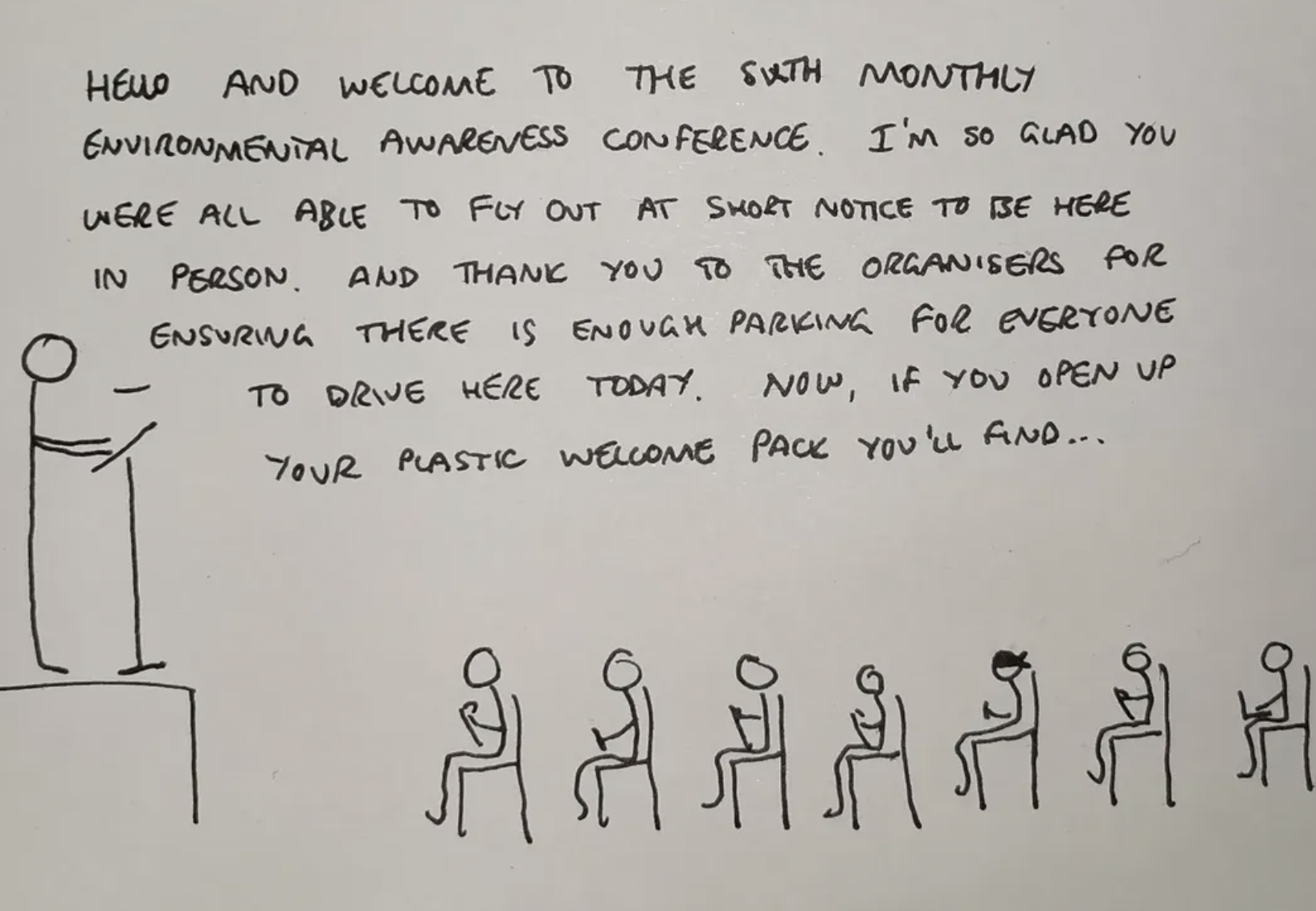
You'll struggle to find an anaesthetist that doesn't agree that anaesthesia is terrible for the environment. You will however find anaesthetists that drive their Land Rover to the airport and then fly long distances to exotic places to attend sustainability conferences discussing just how bad the impact is.
- Approximately 5% of a major hospital's carbon emissions are caused by anaesthesia alone
- Of all the different departments in the hospital, operating theatres generate a disproportionate amount of hospital waste.
Through what mechanisms does anaesthesia contribute to the environmental impact of the hospital?
- Anaesthetic gases
- Energy consumption
- Equipment waste
- Operating department infrastructure - ventilation systems use lots of energy
Some spheres
Who knows what the FRCA will throw at you if a question about sustainability comes up, so may we interest you in some spheres?
- Biosphere - where all the life is happening
- Lithosphere - the land bits
- Hydrosphere - the watery bits
- Atmosphere - the gaseous bits
Biosphere
- Around 8.7 million estimated species on Earth
- 75% of terrestrial biodiversity found in forests
- 50% of habitable land used for agriculture
- 35% of global crop production depends on pollinators
- 50% of the world’s oxygen produced by marine phytoplankton (biosphere within the oceans)
- 30% of emitted CO₂ absorbed by ecosystems
- 1 million species currently threatened with extinction due to human activity
Lithosphere
- 29% of the Earth’s surface is land
- 10–12% of land surface used for crops
- 37% of land used for agriculture (including grazing)
- 1500 billion tonnes of carbon stored in soils (more than the atmosphere)
When soils degrade or are eroded, their ability to store carbon, retain water, and support food production drops significantly.
Hydrosphere
- 70% of the Earth's surface
- 97% of the water
- 80% of life
- 50% of the oxygen produced
- Absorbs 90% of the excess heat
- Absorbs 25% of the excess CO2
40 trillion tonnes of CO2 are stored in the water - fifty times that of the atmosphere.
As the pH lowers and the temperature increases, the ability to store this CO2 drops, and more is released.
Less O2 is dissolved as well, so a whole heap of aerobically metabolising marine animals die out.
Atmosphere
- 78% nitrogen
- 21% oxygen
- 0.93% argon
- 0.04% carbon dioxide and counting
- 99% of atmospheric mass lies within 30 km of Earth’s surface
- 90% of ozone is located in the stratosphere (protects life from UV radiation)
Desflurane and nitrous are particularly potent greenhouse gases.
Plastics
This is probably the highest yield section of the post, given the major argument against TIVA being the holiest of anaesthetic techniques is just how much plastic it uses.
Plastic is made from petrochemicals including crude oil and natural gas. To obtain these resources, processes such as fracking (hydraulic fracturing) literally blow the earth apart to find it.
- Fracking wastewater contains metals, organic material and radioactive compounds
- This water washes merrily into the drinking water supply
- It can cause liver disease, cancer and developmental disorders in children
Then you have to take your hard-won crude oil and gas and process it into meaningfully useful plastics, which in turn produces all manner of carcinogens and neurotoxins.
- So while sevoflurane is destroying the air above us, the TIVA plastics are killing all the plankton
- If you did a blood gas on the ocean, the pH is currently 8.1
- If it drops below 7.95, nearly everything dies.
This is currently expected to happen in approximately... 2045.
And no - 8.4% bicarbonate is not an option here.

If the phytoplankton continue to decline, we lose even more of our ocean's ability to store CO2, and enter a disastrous positive feedback loop of warming and acidification that won't end well for anyone.
Ocean failure is like liver failure - bad news for every other system in the body.
The only difference is you can't do an ocean transplant.
But we can recycle right?
Yes, but it's not that simple.
Recycling is usually better for the environment than just burning stuff and using the heat to produce energy, however it is not without its own drawbacks.
- Processing and transporting waste produces CO2
- The whole recycling process consumes vast quantities of energy
- It can't be done forever
Some stuff, like aluminium and glass, you can essentially recycle indefinitely, so once you've made it you can keep using it again and again, and the only environmental cost is the energy and waste associated with the recycling process.
Plastics are different. They degrade every time you recycle them so you're on a one-way train to releasing microplastics into the environment no matter how conscientiously you recycle them.
- Recycling plastic is still three times better than incinerating them in terms of green house gas emissions
- Glass, metal or paper are better options wherever possible
- The best option is to use as little as possible in the first place
Maybe use that propofol syringe twice?
Moving around
Transporting stuff costs energy however you choose to move it.
Sea vs Air
Air travel is quite obviously disastrous for the atmosphere, as thousands of aluminium tubes paint the sky with CO2 and kerosene every day.
Floating heavy things on a big boat makes more logical sense than trying to lift them up 35 000 feet in the air, however sea transport isn't without its ecological perils.
- Oil spills and discharge from ships kill aquatic life
- Waste water contains a pungent mix of sewage, plastics, detergents and drugs
- Even the paint on the underside of the ship is toxic to prevent build up of marine organisms on the hull
- The engines burn around 14 tonnes of fuel per hour, and the propellers chop the water with such thunderous vigour that animals struggle to communicate and navigate through the deafening turbulence for many miles around
On the road
Over 3% of all road journeys in the UK are NHS related, generating toxic fumes and particulate emissions that, if you churn the stats, probably contribute to over a thousand extra deaths per year.
"Ah but we're going to have electric vehicles soon"
Yes, however there's still the small matter of the battery production, fuels used to charge the damned things and the enormous quantities of rubber and microplastics sheared off tyres of each vehicle, however it's powered.
Drugs
We act as if all of the drugs we give just magically disappear after the patient has woken up. We also celebrate when a drug undergoes 'minimal metabolism' because that means it doesn't matter so much if they have renal or hepatic impairment.
But what this actually means is the drug is just free to go and harm other living things further down the line.
- 90% of all the oral medications taken by patients end up in wastewater in some active form
- The treatment plants aren't able to remove all of these, so they end up in the water and farmers' fields
- Exhaled anaesthetic gases end up unchanged in the atmosphere acting as potent greenhouse gases
Antibiotics
These are arguably one of the worst problems, as they contribute to resistance in the ecosystem and make microbiologists cry fear tears.
Plus as their name suggests, their whole purpose is to destroy living things.
- They trash animals' gut bacteria
- They destroy helpful soil bacteria and stunt plant growth
- They kill off algae and reduce photosynthesis
Yippee.
You still want more?
Okay fine:
- Detergents and bleaching agents kill everything (by design)
- Surfactants destroy fish gills
- EDTA increases bioavailability of heavy metals which kills stuff
- Even paracetamol (and its degradation products) are highly toxic to bacteria, algae and crustaceans
You're getting the point here.
What is the Swedish Chemicals Agency Classification?
This is for aquatic pollutants
- Persistence - how long they stick around
- Bioaccumulation - how much they build up in animal tissue
- Toxicity - how bad they are for you or any other living thing
Atracurium looking pretty sweet right now.
Propofol
I mean you only have to take one look at a vial of propofol to be able to guess that it's probably not great for the environment.
When left in soil and water through unsafe disposal down the sink, it will sit there for over a year.
Propofol has a variety of harmful effects including algae growth inhibition and acute toxicity in small crustaceans and freshwater fish.
And that's before you take into account all of the plastic waste and other emissions required to produce and administer it in the first place.
Deforestation
- The second biggest manmade cause of greenhouse gas emissions, due to loss of an important carbon sink
- A lot of deforestation is for soya bean farming
- Soya bean oil is the largest ingredient in propofol
TIVA divas not looking so smug now.
The main examinable point from the 2024 paper seems to be that propofol isn't fully destroyed until around 1000°C, so you need to put your unused syringes in the sharps bin for incineration, not down the sink.
Otherwise the fishes will be sleeping...with the fishes.
Is it fish or fishes?
- Fish = loads of one species
- Fishes = multiple different species
WHO KNOWS IF THIS IS EXAMINABLE!?
Nitrous and Des
The deadly duo of greenhouse gases, nitrous oxide and desflurane have been shown unequivocally to be absolutely horrendous for the environment, and there is a general trend towards not using them at all.
One key issue is that much of the harm from nitrous oxide occurs from it simply leaking out of the pipeline system, allowing it to still poison the atmosphere even if you're being a terribly virtuous anaesthetist and not using it.
How does one calculate 'carbon dioxide equivalence'?
- Mass released x global warming potential
- Over a 100 year time horizon
Desflurane has around 20 times the CO₂ equivalent of sevoflurane for a typical anaesthetic.
What are the relative GWP100 values for the common anaesthetic gases?
- Desflurane - 2540*
- Isoflurane - 510
- Nitrous oxide - 298
- Sevoflurane - 130
Nitrous oxide has an atmospheric lifetime of around 115 years, meaning it will continue to act as a greenhouse gas for over a century.
*Remember that the MAC value of desflurane is three times higher than sevoflurane, so you're pumping much more of it into the atmosphere as well.
What waste anaesthetic gas capture technologies do you know of?
- Adsorption systems
- Metal-organic frameworks
- Supercritical CO2 condensation systems
What is the environmental impact of oxygen production?
- So when you make medical oxygen by liquefying or fractionally distilling air, you emit around 0.3 g of CO2 per litre of oxygen produced
- Medical air isn't quite so bad at 0.1 g per litre
How low can you go?
Reducing FGF from 6 L/min to 1 L/min reduces volatile consumption by around 80%.
Low flow anaesthesia has other benefits such as improving the humidity and warming of inspired gases, which benefits the patient enormously.
Remember that scavenging simply protects theatre staff from exhaust gases, and doesn't prevent them tearing a hole in the atmosphere.
What are the UK COSHH workplace exposure limits for volatile agents?
- Isoflurane: 50 ppm (8 hour weighted average)
- Nitrous oxide: 100 ppm
Sevoflurane is assumed to be 50 as well.
You can find our whole post on scavenging here:
 Anaestheasier ltd.
Some of those toxins in detail
We're guessing entirely here at what the examiners in FRCA land will question you on, but here are some of the commonly mentioned specific toxins that cause lots of nasty damage to the environment (and people).
Which gases are particularly harmful?
- Sulphur dioxide
- Nitrogen dioxide
- Volatile organic compounds
- Particulates
And you can't pin all the blame on volcanoes and deep sea vents.
Cadmium
- Very toxic to anything with a pulse
- Pneumonitis, bronchitis
- Abdominal pain, nausea and vomiting
- Seizures and coma
- Renal failure
- Osteomalacia
- Carcinogen
Chromium
- Hexavalent chromium easily absorbed and very toxic
- Trivalent chromium insoluble but still terrible
- Respiratory irritation, laryngitis and lung cancer
Lead
- Vomiting and diarrhoea
- Headache, weakness, paraesthesia
- Hypertension and renal failure
- Autism, learning difficulties
- Anaemia and infertility
BTEX compounds
- Benzene, toluene, ethylbenzene, xylenes
- Inhaled and ingestion
- Leukaemia, foetal toxicity and neurological disease
Sulphur dioxide
- Can be inhaled or absorbed through the skin
- Colourless
- Pungent smell
- Forms sulphuric acid in water
- Mainly from motor vehicles and heavy industry
- Particularly bad for respiratory system
Nitrogen oxides
- Inhaled
- Colourless
- Odourless
- Mainly from motor vehicles
- Causes bronchoconstriction even if you don't have asthma
- Worsens asthma and COPD
So what can we do?
We can start by instigating all the little, easy things that have been shown to reduce the environmental impact of our work
Easy things to do
- Turn off unused equipment
- Reduce unnecessary waste
- Use low flow anaesthesia when possible
- Discard unused medications appropriately - usually into the sharps bin for incineration
- Use enhanced recovery protocols to reduce duration of inpatient stay
- Avoid unnecessary cancellations where possible to reduce patient travel
- Do more under regional and local anaesthetic
- Reduce unnecessary use of gloves
- Use recycled, recyclable and reusable stuff
- Feedback to suppliers about bits of kit in procedure packs that are redundant
- If you're doing TIVA, consider using 2% propofol to reduce volume
- Put stuff in the right bin and recycle wherever possible
- Cycle to work
- Let a portion of your garden grow wild
- Make a bug hotel
- Don't eat avocados that have been flown a trillion miles to your local shop
Okay we'll stop now.
Then we need to audit our practice to see what we can reasonably improve within the department in a cost-effective manner.
It is probably a good idea also to accept that whatever we do, anaesthesia (and humans in general) are likely to have an adverse effect on the environment, and not compromise good patient care in the pursuit of overly optimistic environmental metrics.
Here is how your colleagues felt about the exam at the time:
FRCA CRQ
by u/a_sleepy_doctor in doctorsUK
Useful Tweets and Resources
Carbon footprint of total intravenous anaesthesia vs. inhalational sevoflurane anaesthesia in adults: a modelling study#anaesthesia #climate #MedTwitterhttps://t.co/IoKOqV6PDw pic.twitter.com/W3Iuet2bGE
— 𝘈𝘯𝘢𝘦𝘴𝘵𝘩𝘦𝘴𝘪𝘢 (@Anaes_Journal) October 15, 2025
References and Further Reading


Primary FRCA Toolkit
While this subject is largely the remit of the Final FRCA examination, up to 20% of the exam can cover Primary material, so don't get caught out!
Members receive 60% discount off the FRCA Primary Toolkit. If you have previously purchased a toolkit at full price, please email anaestheasier@gmail.com for a retrospective discount.

Discount is applied as 6 months free membership - please don't hesitate to email Anaestheasier@gmail.com if you have any questions!
Just a quick reminder that all information posted on Anaestheasier.com is for educational purposes only, and it does not constitute medical or clinical advice.