Gastric Aspiration

Take home messages
- Aspiration is the leading cause of airway related anaesthetic death
- Use the guidelines and your own judgement together
- Remember Rule 3
It's a big deal
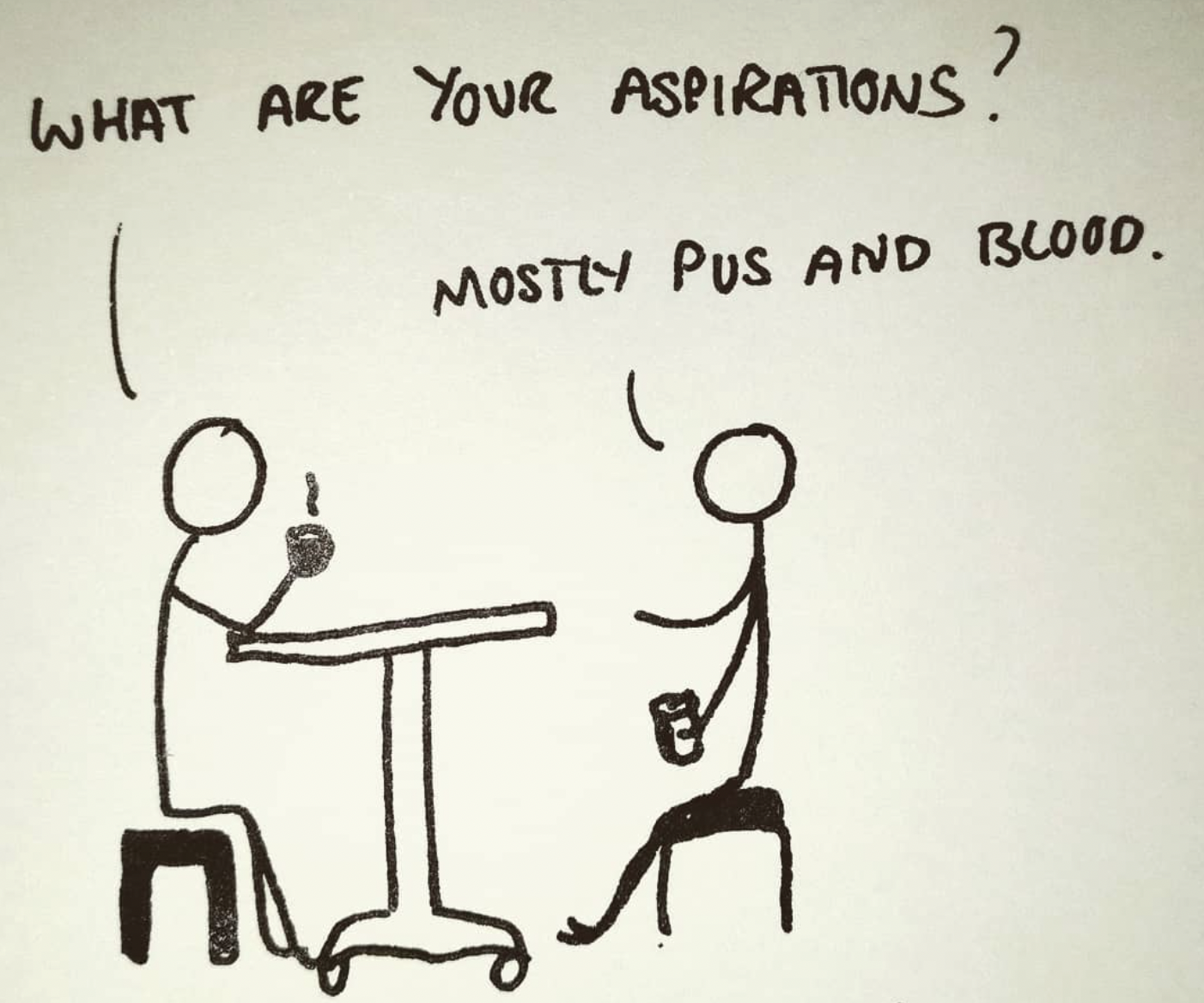
Aspiration is great when it means trying to achieve better things in life.
It's less fun when you're an anaesthetist, and it means something completely different.
When it comes to trying to find a CRQ question that covers judgement, human factors, physiology, anatomy, emergency management and a NAP study all in one go, you'd struggle to do better than asking about gastric aspiration.
What are the current UK fasting guidelines?
- Clear fluids and chewing gum - 2 hours
- Breast milk - 4 hours
- Light meal and formula milk - 6 hours
- Christmas dinner - who knows
There is balance to be struck - fasting for too long risks dehydration, hypoglycaemia, nausea and distress.
Meet Mr Khan
Mr Khan was a sizeable chap, around 117 kg of prime human muscle stretched over 6ft 4 inches, with a benevolent bearded face and strong hands with no veins to be seen whatsoever.
He presented to the surgical emergency assessment unit for his laparoscopic appendicectomy on an unremarkably drizzly Tuesday morning, as instructed by the surgical registrar who had seen him in the emergency department the night before.
He had dutifully gone home and eaten dinner (no later than midnight as requested) and refrained from anything further other than a tiny sip of water at 06:00 that morning.
- He was not diabetic
- He was not taking any opioids
- He was not on any weight loss injections
- He did not suffer with reflux
- He had not been vomiting
He smiled kindly at me as I finally found the faintest tickle of a vein on the back of his hairy spade of a hand and flushed the cannula with relief and the slightly-less-than 2 mcg/kg of fentanyl for induction.
- Monitoring on - no concerns
- Suction ready
- Ramped position to optimise FRC
- Preoxygenated with three deep breaths to an ETO2 of 83%
Maxine the unflappable ODP nodded that she was happy with her equipment.
Go time.
"Alrighty sir, keep those lovely deep breaths going, you're going to feel a cold sensation up your arm, that's completely normal as we drift off to sleep..."
In went the propofol followed by the rocuronium, and I turned to tap the timer icon on the monitor to let me know when the minute was up.
Whoosh
Turning back to look at Mr Khan once more, I could see that not only was the entire facemask now filled with beige fluid, but there were chunks of meat floating between his teeth.
"Oh shit"
- Yankauer in the mouth
- Bed tilted steep head down
- Buzzer pulled
- Beef* removed from oropharynx
- Tube inserted
- Suction catheter down tube
- Lots of flush and suction
- Connected to ventilator
- EtCO₂ confirmed
Deep breaths all round.
*Might have been chicken.
What is it?
Put simply, pulmonary or gastric aspiration involves the inhalation of gastric or oropharyngeal content into the respiratory tract below the vocal cords, representing a failure of the guardians of the glottis to serve their most primary function.
- This can be due to a patient actively inhaling regurgitated stomach content
- It can also be a passive process where refluxing liquid dribbles through paralysed or unprotected vocal cords
How often does it happen?
Uncommonly, thanks to our sensible fasting protocols and risk mitigation strategies, but frequently enough to need to be vigilant.
The reported frequency of aspiration per number of anaesthetic cases varies wildly depending on airway equipment and techniques used, what is deemed to be significant 'aspiration' and whether or not it gets accurately reported.
- In summary it's probably around 1: 1,000 to 1: 10,000 cases.
- Fatal aspiration appears to occur in around 1: 350,000 anaesthetics
That's the key point - when it does happen, it's seriously bad news, and up to 20% occurs at emergence after the tube has been pulled out.
How does it cause problems?
It's not exactly contentious to suggest that bathing your delicate respiratory tree in battery-acid-grade gastric soup is a suboptimal plan, but what exactly happens?
Obstruction
The most immediate and obvious issue is that solid or particulate matter aspirated into the bronchopulmonary tree can cause physical airway obstruction and hypoxia.
Liquid aspirate may not physically obstruct the airway, but can induce atelectasis and VQ mismatch by interfering with surfactant's epic battle with Laplace's law.
This would the be most rapid way in which aspiration could induce a patient's demise.
Mendelson's syndrome
Also called aspiration pneumonitis, this comes next.
- Acidic gastric juice causes a caustic chemical injury to the delicate epithelium of the respiratory tract
- The severity of this injury will depend on acidity and volume
Hence we give a shot of antacid before a general anaesthetic for emergency caesarean section.
This chemical injury is biphasic in nature:
- Direct epithelial damage, causing reduced compliance and increased epithelial permeability
- Inflammatory activation which may then progress to ARDS
This can be anything from asymptomatic to fatal.
Aspiration pneumonia
This comes later, and it's why you'll hear some consultants criticising the routine use of antibiotics after aspiration - because it's not technically infected yet.
- Food is quite good at growing bacteria, especially in the moist, warm, oxygenated and acid-free environment of the lung
- Chronic PPI use can mean gastric content is already colonised with bacteria, which will accelerate this process
You'd be brave to try and justify not giving strong broad spectrum antibiotics to a patient with evidence of significant aspiration.
What are the risk factors for aspiration under anaesthesia?
Classify or die!
Patient factors
- Full stomach
- Delayed gastric emptying - opioids, trauma, diabetes
- Reduced LOS tone - hiatus hernia, pregnancy, obesity
- Reduced airway reflexes - intoxication, neurological disease
Surgical factors
- Emergency surgery
- GI pathology / obstruction
- Laparoscopy
- Lithotomy or head-down positioning
Anaesthetic factors
- Light anaesthesia
- Difficult airway
- Positive pressure ventilation
- Supraglottic airway
- Duration >2 hours
So what volume is safe?
Let's say your patient has followed fasting guidance, but you're concerned that their diabetes, trauma or opioid use means they have delayed gastric emptying and might still be at risk.
So you decide to ultrasound their stomach - what volume is allowed?
- The idea of 25ml being the cutoff is rather antiquated and most fasted patients exceed this
How to do it
Examine the gastric antrum with the patient in the supine and right lateral positions.
Give a qualitative grading:
- Solid or thick fluid
- Clear fluid
- Empty
Then measure the antral cross sectional area
How is gastric ultrasound used to assess aspiration risk?
Ultrasound assessment of the gastric antrum estimates content and volume.
A patient may be considered functionally fasted if:
- Contents are clear fluid only, and
- Estimated gastric volume is <1.5 mL/kg
Solids or >1.5 mL/kg = treat as full stomach.
This is particularly useful when you're unsure if the patient has followed fasting guidance, if you're concerned about gastroparesis or delayed emptying.
Okay so cricoid?
Grrr.
We're biased, and you can read our full rant here:
 Anaestheasier ltd.
Long story short, in the UK as an anaesthetic trainee, DAS and the RCOA recommend that you should be using cricoid force as part of your multi-modal anti-aspiration plan, even if cricoid force is a heap of useless garbage that may even do harm.
Rant over.
What are the problems with cricoid force?
- Oesophagus is frequently laterally displaced and therefore not compressed
- Worsens laryngoscopy view
- May occlude airway
- Leaves you with a one-handed assistant
- Risks oesophageal rupture in the case of forceful vomiting
Ask for cricoid to start with, but if you're having any difficulty viewing the cords at all, then remove it.
In the exam say this:
Killer Mounjaro?
The recent addition of GLP-1 agonists and other weight loss drugs has rather complicated things.
- They're designed to slow gastric emptying
- We don't know how much they increase risk
The safest thing to do as the registrar on call is to treat any patient on weight loss drugs of this class as if they were unfasted.
When it comes to scheduling elective surgery and deciding to cancel a case on the morning because of fasting concerns, it gets a smidge more complicated.
This article is very useful:
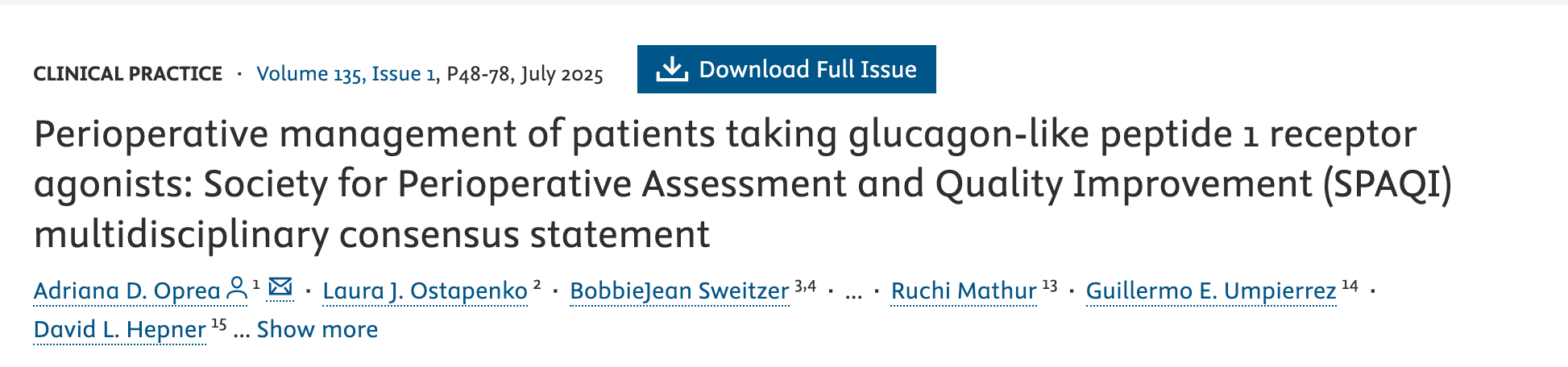
In summary they recommend:
- Continue GLP-1 agonists perioperatively in patients without significant nausea or vomiting
- Patients should fast for solids fo 24 hours before surgery
- Patients can have high-carbohydrate clear fluids up until 8 hours before surgery
- Patients can have other clear liquids up until 4 hours before surgery
- Patients with significant nausea and vomiting or unable to tolerate oral intake should not have elective surgery, and should be referred to their prescribing physician for diet and medication modification before proceeding
- Patients can restart their GLP-1 agonists once back to their normal diet postoperatively
Useful Tweets and Resources
More around #GLP-1RA’s and #fasting – does an overly restrictive regime introduce unintended harm? What #factors affect #pulmonaryaspiration risk? https://t.co/TqGYdlYNJm pic.twitter.com/IJtcQsWt2p
— British Journal of Anaesthesia (@BJAJournals) January 28, 2026
Not related but weird:
Images in #Anesthesiology - A Chest Tube Inadvertently Inserted into Tracheal Lumen 📷 https://t.co/xAiYSiQ0Ar pic.twitter.com/oESkFlyulz
— Anesthesiology Journals (@_Anesthesiology) May 12, 2023
References and Further Reading
 Anaestheasier ltd.
 Anaestheasier ltd.

 wendykingdoctors.org.uk

Primary FRCA Toolkit
While this subject is largely the remit of the Final FRCA examination, up to 20% of the exam can cover Primary material, so don't get caught out!
Members receive 60% discount off the FRCA Primary Toolkit. If you have previously purchased a toolkit at full price, please email anaestheasier@gmail.com for a retrospective discount.

Discount is applied as 6 months free membership - please don't hesitate to email Anaestheasier@gmail.com if you have any questions!
Just a quick reminder that all information posted on Anaestheasier.com is for educational purposes only, and it does not constitute medical or clinical advice.
Anaestheasier® is a registered trademark.