Defibrillators
"Okay pause for rhythm check, off the chest please."
'Looks shockable.'
"Back on the chest, charging, everyone else away please."
Booooooooooooooooooop. Beep. Beep.
"Okay off the chest, stand back, oxygen away."
BOOMF.
"Back on the chest, let's go through our H's and T's."
I'm assuming this script sounds rather familiar, but do you actually know what goes on when you press that flashing red button that might just bring the patient back from the dead?
What does a defibrillator actually do?
Contrary to popular belief, a defibrillator does not restart a stopped heart.
It de-fibrillates, meaning it tries to untangle a chaotic and ineffective electrical rhythm and allow the coordinated, methodical transduction of electricity through the conducting system to resume.
This is a very important distinction.
- Fibrillation means 'flapping about and achieving very little'*
- Atrial fibrillation isn't great, but you still have a cardiac output
- Ventricular fibrillation is terrible, because you don't have a cardiac output
(*For example "The orthopaedic SHO was fibrillating at the medical emergency")
By firing a high-energy pulse through the myocardium, it's trying to depolarise enough cells at once to terminate the chaotic VF or VT that's currently preventing effective contraction, and allow the sinoatrial node to re-establish control.
A spot of history
Let's drift back all the way to 1899 and say hello to Prévost and Battelli, who found that electrical shocks could flip a heart into, and back out of, ventricular fibrillation in experimental animals.
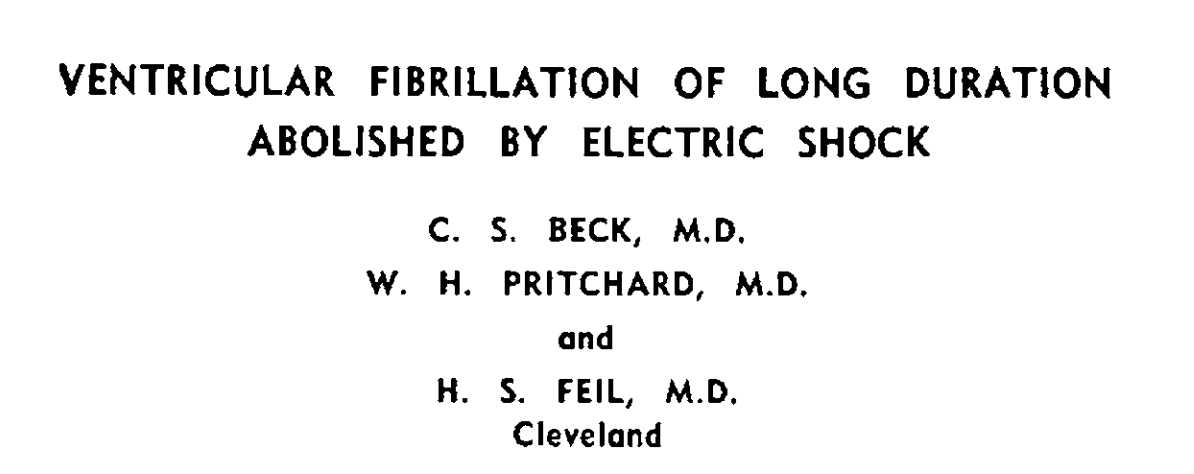
It wasn't until 28th October 1947 that American cardiac surgeon Claude Beck performed the first (documented) successful defibrillation of a human heart.
He did so during surgery for pectus excavatum, applying electrodes directly to the myocardium, and managed to zap a 14 year old boy back to life with 110 volts of home-made alternating current, after 70 minutes of resuscitation.
He was apparently discharged a month later with no neurological injury.
Only in Ohio.
Here's the paper
Then in 1956, Paul Zoll (whose name may be on your defibrillator) demonstrated successful external defibrillation without opening the chest, using AC current in humans, and in 1962 Bernard Lown introduced DC cardioversion using a capacitor, making the whole process a little safer than plugging people into the mains.
The first automatic implantable ICD came along in 1980, courtesy of Mirowski et al., and since the start of this millennium we've been graced with the reassuring presence of automatic external defibrillators on the corner of every high street.
FRCA questions you might get asked
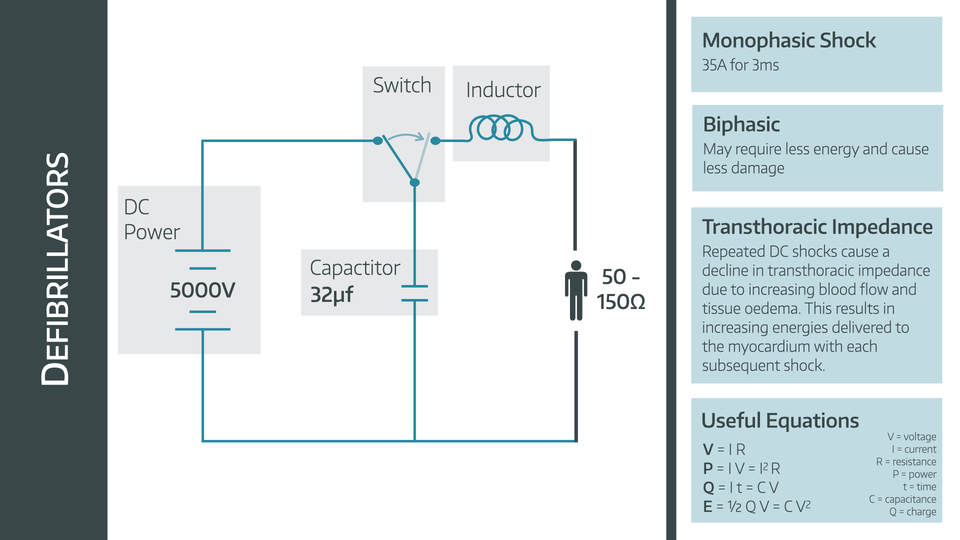
What are the steps involved in a defibrillator circuit?
- Power supply (battery or mains) provides electrical energy to the charging side of the circuit
- This charges the capacitor
- The capacitor stores the electrical energy required for the shock
- The operator hits the switch to complete the output side of the circuit
- The capacitor discharges, providing a controlled waveform through the electrodes to the patient
- An inductor slows the rate of discharge to increase the duration of the shock
- Modern biphasic defibrillators reverse the direction of current flow during the shock
What is a capacitor and how does it store energy?
- A capacitor is an electrical component that stores charge
- It does this by storing electrical energy in an electric field between two conducting plates that are separated by an insulator called a dielectric
- Capacitance (F) = Charge (Q)/Voltage (V)
- It can then release this charge very rapidly into the circuit
A defibrillator capacitor has a capacitance of around 100 microfarads and is charged to 2,000 V.
- Energy = 0.5 x Capacitance x Voltage²
This means around 200 J of energy is stored, which is what you select on the control panel.
Note that the amount of energy received by the patient will depend on other factors as well, such as the circuit design, electrode contact and the patient's own thoracic impedance.
What is the role of an inductor in a defibrillator?
- An inductor is essentially a posh coil of wire
- This generates a magnetic field when a current passes through it
- This magnetic field will then oppose any changes in current
- Its role is to limit the rate at which the current in the output circuit increases, and to help shape the waveform that is delivered to the patient
This is the traditional answer for a monophasic defibrillator. Modern machines use complex electronic switching to shape the waveform that is delivered to the patient, but for FRCA exam purposes you just need to be aware of what an inductor does.
A capacitor opposes rapid changes in voltage, while an inductor opposes rapid changes in current.
What is the difference between monophasic and biphasic defibrillation?
- Monophasic - current flows in one direction between the electrodes
- Biphasic - current flows in one direction, then reverses halfway through the discharge process
This is different to AC vs DC, which distinguishes electrons that are oscillating back and forth from those that are flowing round a circuit.
Defibrillators produce a brief pulse of DC current, that rapidly reverses direction halfway through the discharge.
- Biphasic defibrillation seems to be effective at much lower energy levels (150 - 200J rather than 360J)
- Biphasic defibrillators are now standard and you probably (hopefully?) won't find yourself using a monophasic device anytime soon.
What determines the amount of current passing through the myocardium?
Current depends on voltage and resistance, but the human thorax isn't exactly a 'simple' resistor in the circuit, and many factors affect how much electrical juice reaches the naughty fibrillating myocardium.
- Energy setting
- Transthoracic impedance (adiposity and its distribution)
- Pad size and position
- Defibrillator design
So when you select '200J' on the defib, that's not exactly how much energy is being delivered to the heart.
What is transthoracic impedance and what affects it?
Leading directly on from the previous question, impedance is the opposition to the passage of electrical current.
- Resistance is the term used in DC circuits
- Impedance is used for AC circuits because you have to think about reactance (the opposition to the current switching direction) as well as resistance
While the shock delivered by the defibrillator is technically a DC pulse of electricity, we use the term 'impedance' because of the fact that the pulse changes direction halfway through, is not a steady state current, and the thorax is far from a simple resistor.
This change in direction means there will be 'reactance' as well as resistance, making 'impedance' the technically more correct terminology.
If you get examined on this, I'll be utterly astounded, but it will be useful if you're ever trying to impress a cardiac physiologist.
Both impedance and resistance are measured in ohms (Ω).
Usually an adult thorax offers up around 50-100 ohms of impedance, but this will be influenced by:
- Body hair
- Skin preparation
- Electrode contact
- Pad size and position
- Thoracic anatomy
- Respiration
More impedance = less electricity delivered to the myocardium.
Why is cardioversion synchronised to the R wave?
You want to deliver the bolt of chest lightning when the ventricle is depolarising, not when it's trying to repolarise.
- The R wave is the bit of the ECG corresponding to ventricular depolarisation
If you bash a heart that's in SVT or pulsed VT when it's trying to repolarise, you risk flipping it into the decidedly worse ventricular fibrillation.
Of course then you can just bash it again, but that's hardly ideal.
The key point here is that once you've synchronised the shock (confirmed by the presence of little arrows pointing at every R wave on the monitor) you must push and hold the shock button, as the machine will wait until the next complex to deliver the impulse.
What energy would you use to defibrillate an adult in VF?
Technically speaking it depends on exactly what sort of defibrillator you're looking at.
Realistically speaking the answer is 150 - 200 J.
If you're using a monophasic defibrillator, then the number is 360 J.
If you're unsure, and have a patient in VF in front of you, just set the machine to its maximum setting and get on with it.
The advice from the updated 2025 Resus Council guidelines is as follows:
- For biphasic waveforms (rectilinear biphasic or truncated exponential biphasic, but not pulsed biphasic), defibrillation shock energy levels for the first shock should be at least 150 J
- For pulsed biphasic waveforms, deliver the first shock at 130-150 J
- If the first shock is not successful and the defibrillator is capable of delivering shocks of higher energy, it is reasonable to increase the energy for subsequent shocks
- If the rescuer is unaware of the recommended energy settings of the defibrillator, for an adult, use the highest energy setting for all shocks
- Use standard energy levels in obese patients
Where would you put the pads?
You have two options.
- Anterolateral
- Anteroposterior
Anterolateral positioning is as follows:
- Pad 1: Parasternal below the right clavicle
- Pad 2: Left mid-axillary line over V6
Anteroposterior positioning is:
- Pad 1: Parasternal on the left
- Pad 2: Medial to the left scapula at the same height
Other things to consider:
- Ensure good electrode contact
- Consider shaving body hair
- Avoid implanted devices
How would you manage VF that persists after three shocks?
- Keep going with high quality CPR and minimise interruptions
- Optimise airway and oxygenation
- Increase the energy setting
- Check pad positioning
- Consider a vector change, i.e. switching to AP positioning
- Give adrenaline and amiodarone as per ALS protocol
Note that three stacked shocks for witnessed, monitored VF do not count as three shocks for the purposes of the ALS algorithm, they count as the first 'shock' in the flowchart.
What are the risks of defibrillation in theatre?
- Accidental electrical injury to staff
- Fire in an oxygen-enriched environment
- Injury to patient
- Interruption of effective resuscitation
Make sure nobody is touching the patient or bed, the pads are correctly positioned and anything pouring high concentrations of oxygen into the room is moved at least a metre away from the patient's chest.
Oh, and don't shock asystole.
References and Further Reading



Other physics and equipment posts


Just a quick reminder that all information posted on Anaestheasier.com is for educational purposes only aimed at trained professionals, and it does not constitute medical or clinical advice.
Everything on this website is written by a trained (human) anaesthetist unless explicitly stated otherwise. LLMs may be used to assist with research and proofreading, but all writing is done by hand.
Anaestheasier should not be used as a definitive resource for academic writing; please reference original source material.
Anaestheasier® is a registered trademark.